
Update No.18
March 2026
This edition focuses on real estate – specifically, what Merito Partners has built, what the numbers look like, and where the strategy is heading next. It covers why Riga is the right market, what the portfolio has delivered in less than 30 months of execution, and Arhitektu nams – the most ambitious project yet and a preview of where this strategy is heading.
It has been just over two years since Merito Partners closed its first real estate fund. In that time, the strategy laid out in Newsletter No. 15 has moved from thesis to track record – and the results are giving every reason to accelerate.
Three things are covered here. First, why Riga is the right market – and why the window is not permanent. Second, what the portfolio has delivered in less than 30 months of execution. And finally, Arhitektu nams – the most ambitious project yet, and a signal of what comes next.
Walk through central Riga on a weekday morning and you will see something increasingly rare in a European capital: buildings worth restoring, priced as if nobody wants them. We think quite a lot of people will want them soon.
A decade of caution left Latvia behind
The 2008 financial crisis hit Latvia harder than almost any other European economy. Property prices collapsed by more than 50%. Households spent years paying down debt rather than taking on new mortgages. Banks tightened standards. Developers stayed on the sidelines. It was a rational response to a genuine shock – but it created a structural gap that persists today.
That gap is most visible in Latvia’s mortgage market. As of Q3 2025, outstanding mortgages and real estate loans in Latvia stood at roughly €8.4 billion – a fraction of Lithuania’s €14.6 billion and Estonia’s €12.8 billion. Traditionally, the vast majority of mortgages are concentrated in capital cities with comparable populations and income trajectories, presenting a major opportunity for Riga. Outstanding loans to real estate and construction tells the same story: €2.4 billion in Latvia, versus €4.5 billion in Lithuania and €5.6 billion in Estonia (Source: CBL AM calculations based on data from Central Banks of the Baltic States Q3 2025).
This is not weakness – it is latent demand. A population that has historically underinvested in homeownership, in a market where the conditions for doing so are now improving rapidly. As Latvian banks increase their appetite for real estate lending the pool of mortgage-eligible buyers expands. More buyers, same supply constraints. Supply, incidentally, is not rushing to catch up. New apartments entering the Riga market fell short of 2,200 units in 2025. The Colliers Latvia Residential Report 2025 projects roughly 2,500 units for 2026, rising to 3,000 in 2027 – enough to absorb demand at current pace, but not enough to rebuild the inventory buffer that the market has been drawing down (Source: Colliers Rigaarea25 Residential report).
The price gap that cannot last
Which brings us to the number that matters most for investors analysing the return potential. New project apartments in Tallinn average: €4,370 per square metre. Vilnius: €4,050. Riga: €2,950. A 30–40% discount for a city with comparable history, urban quality, income level and professional workforce (Source: CBL AM, Market Outlook 2026).
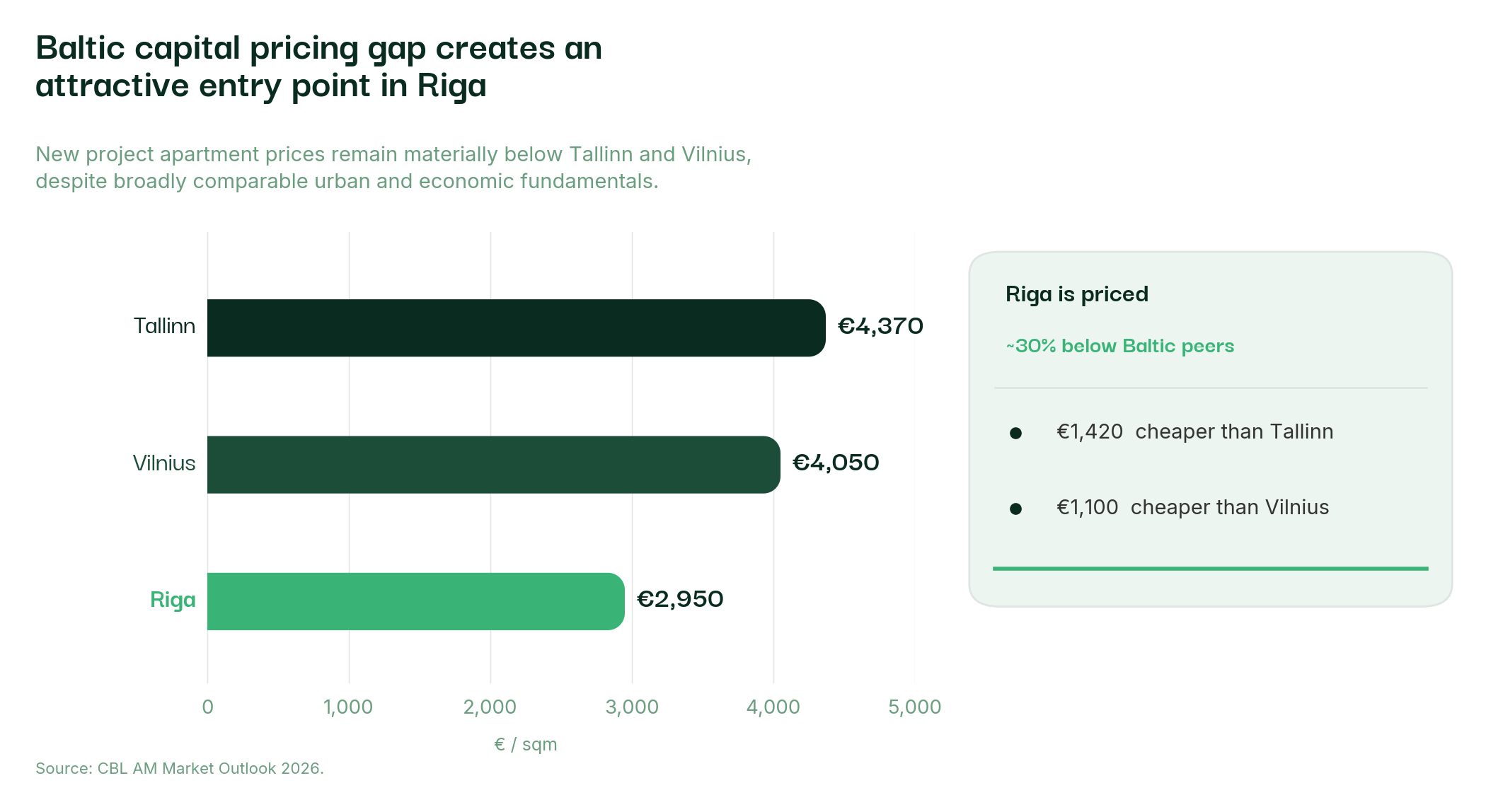
That gap is not explained by demand – Riga’s primary market recorded 2,186 registered transactions in 2025, up 38% from 2024, generating a record €310 million in total deal value (Source: Colliers Latvia 2025). It is not explained by construction quality – the same developers active in whole Baltics are building in Riga. It is explained by the post-crisis undersupply, the recovering mortgage market, and the lag in developer confidence – all three of which are now visibly reversing.
When Colliers surveyed the active pipeline heading into 2026, developers who had been sitting on the sidelines through 2022 and 2023 were announcing large-scale projects and expanding land banks. Developers do not do that if they expect prices to fall.
For repositioning projects with 24–36 month horizons, the combination of low entry prices, expanding buyer pools, and a closing valuation gap creates a return profile that is difficult to replicate in markets that have already re-rated. That is the environment in which our real estate strategy operates – and that is why we are moving now.

We said in Newsletter No. 15 that Merito Real Estate Special Situations would run on two principles: partnering with agile developers who put their own capital at risk alongside ours, and targeting repositioning of undervalued or mismanaged assets that the market has mispriced. The question was always whether execution would match the thesis. We can now answer that.
The two approaches in a nutshell
1st Approach: Partner with developers who co-invest 15–35% of capital, accept an investor-first return structure, and operate under a Shareholder Agreement with Merito as an appointed Management Board member. The developer brings execution skill. We bring disciplined capital and governance. Interests are aligned from day one.
2nd Approach: Find properties that are undervalued, mismanaged, or simply underused – and reposition them through a focused 24–36 month strategy. Not speculative development. Not long holding periods waiting for macro tailwinds. Active value creation: acquire, renovate, convert, exit.
These are not abstract principles. Every fund in our portfolio – from the first closing in late 2023 to the latest one in 2026 – has been structured around one or both of them.
Where we started, and where we are
December 2023. Merito closes its first real estate fund – Kalēju 18/20, a property in Riga’s Old Town – with nine investors and €1.3 million in committed capital. At the time, we had no track record in real estate. What we had was a thesis, a team with deep local market knowledge, and the discipline to structure every deal with investor protection first.
By February 2024, we had closed a second fund – Pasta Street 6. By the second half of 2025, we were running six new funds in parallel, covering projects from Brīvības Street 138 to Skanstes Hof. Today, across ten funds, approximately 80 investors have made nearly 180 individual investment commitments, totalling close to €20 million.


The pace has not been accidental. Each new fund has benefited from the lessons of the previous one – better deal structuring, due diligence, tighter governance, more experienced counterparties.
The results that matter most
Pasta Street 6 is the clearest proof of concept so far. Acquired in February 2024 for a total investment of approximately €5 million including bank debt, the property’s market value had reached 2.0x Equity Multiple by June 2025 – a period of roughly sixteen months. All investor equity is already fully repaid and exit planning is underway. Expected returns in the range 20–30% IRR per annum. It was income-generating within 14 months of acquisition.
2025: The year execution became visible
2025 was the year the Merito real estate strategy moved from something investors trusted on paper to something they could see working in practice. Six new funds launched. Four of them under the developer-partnership model, two under the repositioning model.
The deals covered a range of property types – a former scientific facility on Krīvu Street, a historic residential block on Brīvības Street, a residential development project on Ģertrūdes Street, a new residential development at Hospitāļu Street in partnership with InCity Capital. Each project different. Each structured the same way.
Every now and then, a project comes along that does not just fit your strategy – it defines it. Arhitektu nams is that project for Merito Real Estate.
The building at Skolas Street 21 has stood in the Quiet Centre of Riga since 1987. Designed to house the Design Institute, it was built with the kind of structural generosity that Soviet-era public commissions occasionally produced: a reinforced concrete frame that has outlasted its original purpose by decades, high ceilings, wide corridors, and five elevators – a genuine rarity in buildings of this era and scale. It covers over 9,000 square metres. And until recently, it was sitting largely underused, its potential invisible to most of the market.
We acquired it for €5.9 million, co-financed with AS Signet Bank contributing €3.85 million. The total investment in the project is expected to surpass €14 million by completion.
What we are building
The transformation plan is straightforward in concept, demanding in execution: convert the building into approximately 250 compact studio and one-bedroom apartments, sized between 17 and 35 square metres, designed for the people who actually want to live in central Riga – students, young professionals, expats, long-term visitors. People for whom location matters more than space, and for whom the alternative is usually an ageing Soviet-era flat in a suburb, or an overpriced modern unit in a building that lacks character.
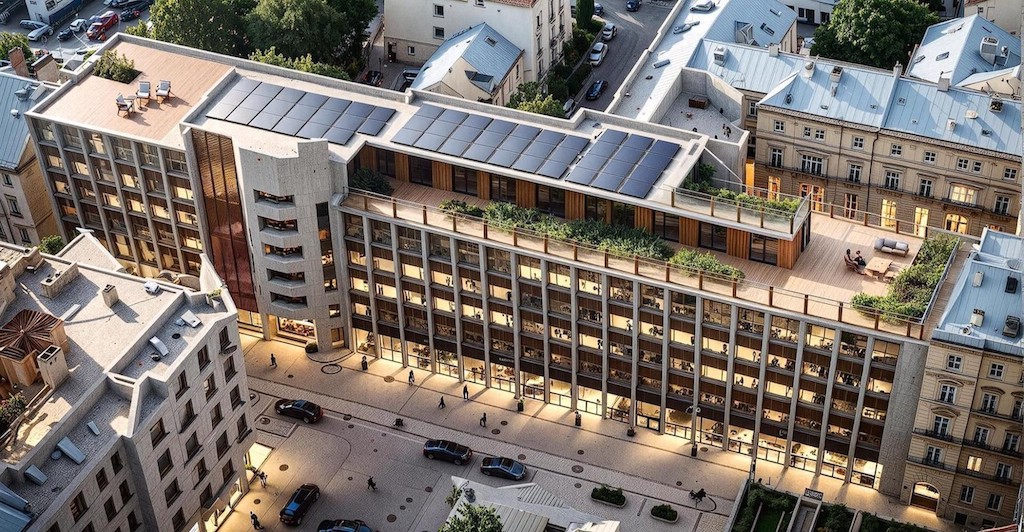
The Quiet Centre location is not incidental. Skolas Street 21 sits within walking distance of all key cultural and historical landmarks in central Riga and the established professional quarter of central Riga. It is, by any reasonable measure, a prime address – and it has been priced like it is not.
Beyond apartments, the plan incorporates commercial ground-floor space, co-working and recreational areas, storage solutions, and dedicated bicycle parking. These are not afterthoughts. They are the features that make a building genuinely liveable for the target demographic, and that drive long-term occupancy and rental income.
The numbers
| Acquisition price | €5.9 million |
| Bank financing (Signet Bank) | €3.85 million |
| Total investment expected | >€14 million |
| Building footprint | >9,000 sqm |
| Target output | ~250 studios & 1BR apartments (17-35 sqm) |
| Equity raised | €3.9 million from 22 private investors |
| Investment horizon | 36 months – renovate, convert, sell |
| Target net IRR | 20–30% per annum (MOIC ~1.8×) |
| Environmental advantage | ~50% lower impact vs. comparable new build |
The environmental case is worth emphasising. Renovation of an existing concrete frame produces roughly half the carbon footprint of a comparable new construction. In a market increasingly attuned to sustainability credentials – and where EU green standards for residential buildings are tightening – this is not just an ethical argument. It is a commercial one.
A template, not a one-off
What makes Arhitektu nams significant is not just the scale – though at over 9,000 square metres and €14 million in total investment, it is the most ambitious project to date. What makes it significant is what it demonstrates: that Merito can identify, structure, and execute a project of this complexity with the same discipline applied to a €1.5 million single-building fund.
Work is already underway on another project that will exceed Arhitektu nams in scale. It is not ready to be announced yet – but it will be soon. What can be said is that investor appetite has been the clearest signal that this strategy is working. Across the portfolio, the total value of RE assets has reached €80 million, and plans already call for more than 600 new apartments across all projects.
The pipeline is not slowing down. It is accelerating. And we want our investors to be part of what comes next.
Interested in our next opportunity?
If the strategy we have described in this newsletter resonates with you – or if you are an existing investor curious about upcoming projects – we would be glad to talk.
📧 investor.relations@meritopartners.com
— The Merito Partners Team