Merito Partners Newsletter Q3 2026

Update No. 20
September 2026

This edition focuses on real estate: what the portfolio has actually returned, how the live projects are set up, and a new way to hold the strategy. It covers Merito’s first exit and the capital that has come back to investors, why Riga’s new-build segment still has not repriced with the rest of the market, and Real Estate Feeder Fund I.

It has been two and a half years since Merito Partners closed its first real estate fund. In that time the strategy set out in Newsletter No. 18 has moved from thesis to distributions. Four funds have returned investor capital in full, each within 16 to 24 months of inception, the first profit has been paid out, and the portfolio now runs to more than 1,000 apartments across fourteen funds.

SECTION 1
The First Exit
Kalēju 18/20 has distributed its first profit at a realised 30% IRR. Four funds have now returned investor capital in full.

Kalēju 18/20 was the first fund and it is the first to return profit. Seventeen units in Riga’s Old Town, bought as a single lot for €2.9 million against a valuation of roughly €4.5 million if sold unit by unit. The work was everything in between: separate the units, fix them, design, renovate, furnish, operate, build a track record, sell. €1.0 million of profit has now been distributed to the nine investors in the fund: a realised 30% IRR and 1.8x on capital, against the 20–30% targeted at launch. The follow-up sale of the ground-floor units is expected to bring the IRR into the 35–40% range.
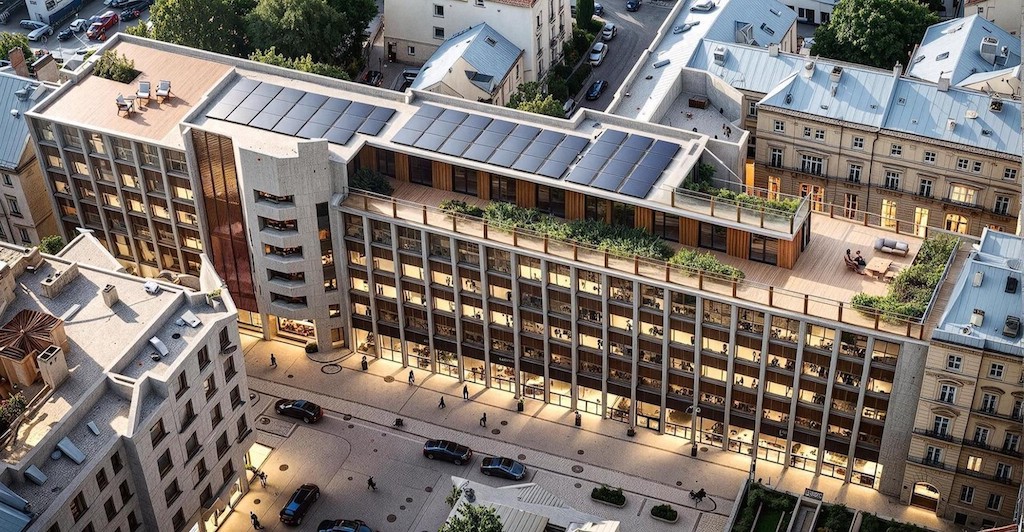
Kalēju 18/20, Riga Old Town

Three more funds have returned investor capital in full, each within 16 to 24 months of inception. The speed matters here as much as the multiple. Pasta 6 has returned the full €2.1 million raised in February 2024, with the exit itself still in progress. Ulmaņa gatve 2 has repaid its €2.5 million; that asset (40,000 m² of industrial space on a 6.5-hectare leasehold) is carried materially above acquisition cost and is now in strategic review, where we are weighing a hold against a sale. A fourth fund returned capital with a small positive return after the transaction was terminated by the seller (confidentiality obligations prevent us from naming it or going further). A fifth is contracted to return 100% of capital in Q4 2026, fourteen months after inception.

The portfolio as it stands

Fourteen real estate funds have been launched since December 2023. More than €28 million has been raised across them, over €11 million has been distributed back, and the projects in the portfolio carry a combined sales value of roughly €120 million.

14
Funds launched
€28m+
Raised from investors
€11m+
Distributed back
€120m
Portfolio sales value

Who is behind it

Around 100 investors have made over 240 separate commitments to Merito real estate funds: an average of close to three funds each, at an average commitment of around €115,000. Roughly half have backed a single fund so far; at the other end, a core group of five has backed nine or more. That pattern matters more to us than the headline number. It means the portfolio grows mostly because people who have invested with us come back for the next one, and it is why a raise can close in days rather than months.

The portfolio deliberately spans four different kinds of work rather than one: building new residential from the ground up; converting historic and Soviet-era buildings to modern residential use; buying stranded assets and selling them down unit by unit; and adding value to industrial property. That mix means we are never dependent on a single exit route or a single type of buyer, and it lets us be selective about which assets we back.

One exit distributing profit, four funds with capital returned, €11 million+ back to investors. The pipeline brings a new opportunity to investors roughly every second month.

SECTION 2
The Price Gap, and Building Into It
Riga still trades well below Tallinn and Vilnius. Three live projects show three different ways of capturing that.

The case for Riga has not changed since we set it out in Newsletter No. 18. Apartment prices in Vilnius rose 11.1% in the twelve months to April 2026 and 12.1% across Lithuania’s largest cities, on the Ober-Haus index. Tallinn has been the slowest of the three capitals — new-build prices there have barely moved in two years and transaction volumes are still close to their lowest in over a decade — and that matters less than where it stalled: a new apartment in Tallinn still averages around €4,200 per m², against roughly €2,600–2,850 in Riga’s primary market. Even standing still, Tallinn is priced about 50% above Riga. Latvian housing prices overall moved at around 11%, but new-build prices rose only 4–5%: Latvia’s statistics bureau recorded new-dwelling prices up just 1.2% year on year in Q2 2025 against 8.3% for existing dwellings, and the pattern has held. The segment we actually operate in has not repriced with the rest of the market. And because Vilnius is compounding from a higher base while Tallinn simply sits on one, the absolute gap in euro per square metre between Riga and both peers has widened rather than closed.

Demand underneath that is real and financeable. Latvijas Banka reported household lending up 10.6% year on year at the end of June 2026, with mortgage lending up 9.5% and new housing loans running at about €120 million a month through the first half. Total domestic credit still stands at only 31.8% of GDP against a euro area average of around 73%, so the room to grow is structural rather than cyclical. That growth has continued through a turn in the rate cycle (the ECB moved rates up again in September), which tells us the demand is coming from households and banks catching up on a decade of under-lending, not from cheap money.

Supply is not keeping up. The number of apartments on offer in Riga was down 24% year on year by August 2025, with stock in the largest housing estates down 26% (Arco Real Estate), and the imbalance is regional: in Vilnius, developers completed 2,787 apartments for sale in 2025 against more than 5,700 sold on the primary market (Ober-Haus). Latvia also leads the EU on overcrowded housing, well above both Lithuania and Estonia.

Three projects, three different approaches

Brīvības 138: closest to cash. A historic building on one of Riga’s main arteries, converted to around 90 apartments: the original scheme had 78 units including commercial premises, and splitting the largest apartments lifted the count. Construction is well advanced, roughly two-thirds of the apartments are reserved and signing of the purchase agreements started in July. The value here comes from execution speed: the product is nearly finished and the buyers are already committed, so this is the shortest path to distributions of the three. Targeting 20–30% IRR annualy.
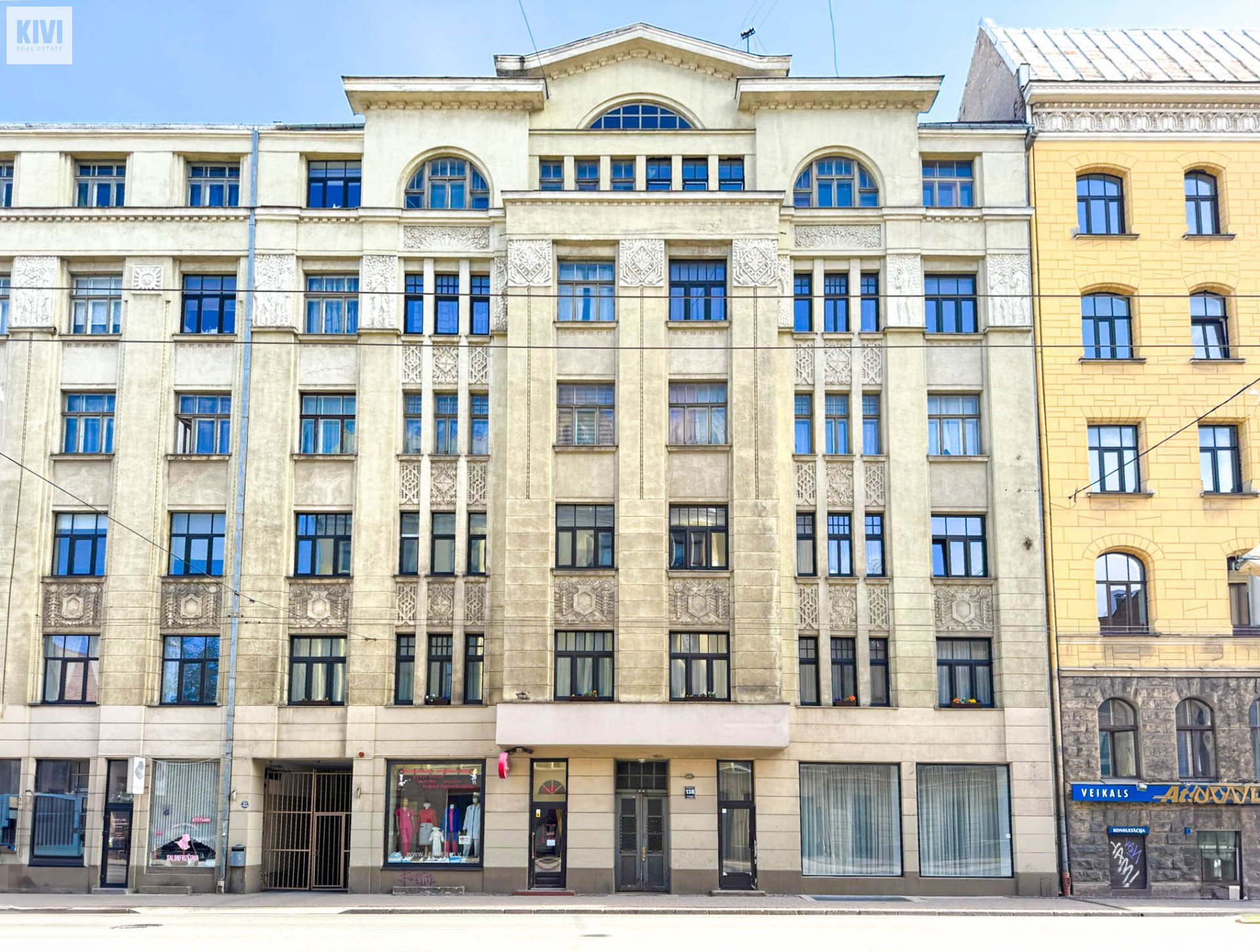
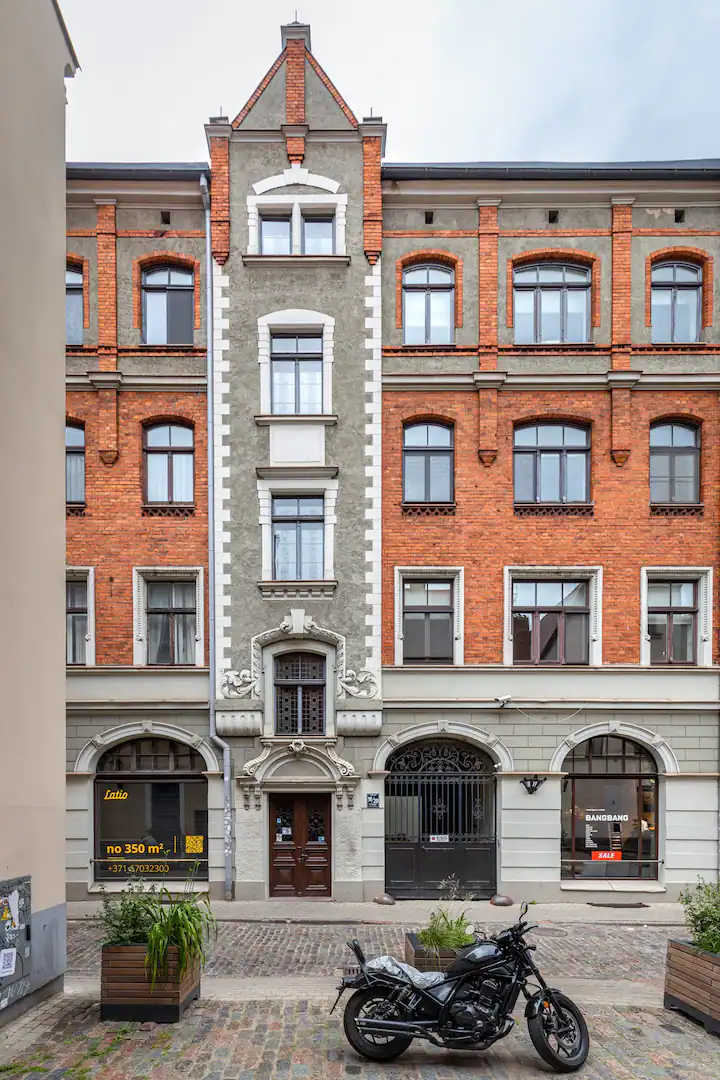
Brīvības 138, Riga

Fiziķu nams (Krīvu 11): changing what a building is for. A former scientific facility that nobody in the market had a use for, becoming 117 apartments. Demolition and clean-up are complete and the fund is fully subscribed at €2.5 million. The value comes from the conversion itself: we bought a building priced for its old purpose and are giving it a new one, which is the least competitive way to buy square metres in this city. Targeting 25–40% IRR annyally: the widest range of the three, because a conversion of this kind carries the widest spread of outcomes.

Krišjāņa Valdemāra iela 55, Riga

Hospitāļu 49 (Skanstehof): the new-build furthest along. Ground-up construction rather than conversion, and the most advanced of our new-build projects: the building is roughly half built and about a quarter of the 33 apartments are already reserved. The value here comes from building at a cost set before the current market and selling into it: a straightforward development margin, with none of the permitting or heritage risk the conversions carry. Targeting 17–25% IRR annualy.
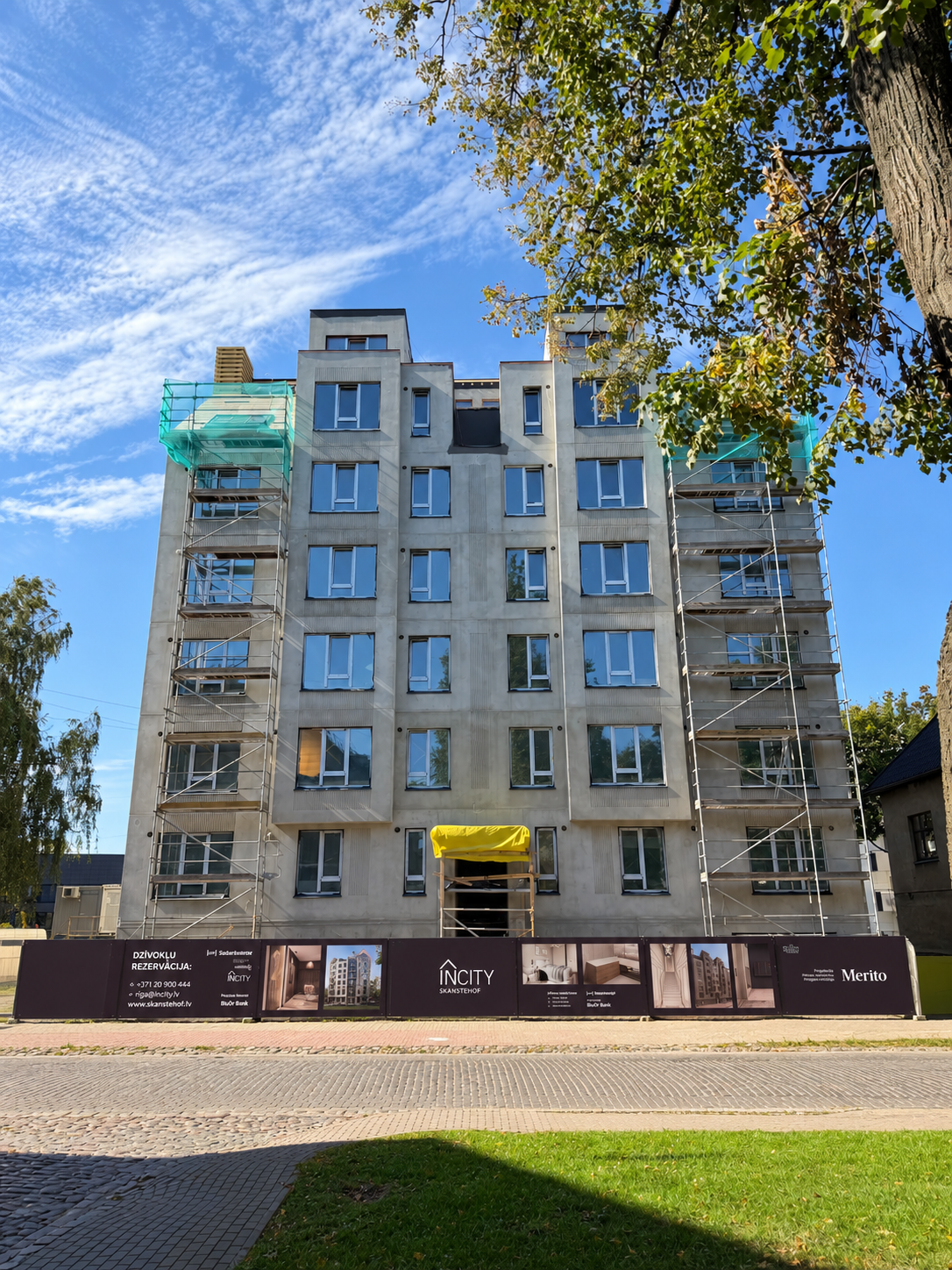
Hospitāļu 49, Skanstehof, under construction

Different entry logic, different duration, different risk, to fit different investor preferences, with the same discipline underneath each one.

How fast this moves

The clearest signal we get is how quickly investors commit. We announced the Valdemāra 55 fund (Club Central Residence III, Phase 1) on a Wednesday. Within roughly thirty hours the fifteen investors needed had confirmed the full amount, and we closed the raise and told everyone else the project was no longer available. Final commitments came to €1,655,000 against a €1.6 million target. That is a good problem, but it is still a problem: if you are not on the list early, you miss projects.

SECTION 3
A New Route In: Real Estate Feeder Fund I
Built for larger, more institutional investors (professional family offices and similar) who want an allocation, not a building.

Every project described above sits in its own single-asset fund: one building, one vehicle, one decision. But it puts real work on the investor. You have to pick, keep picking, and be available when a raise opens and closes inside two days.

Real Estate Feeder Fund I is our answer for investors who want exposure to the Merito real estate portfolio through a single investment. One commitment is spread across up to ten of our single-asset funds, at between 5% and 25% per fund, so no single asset can dominate the outcome. Minimum commitment is €500,000 and total commitments are capped at €5 million. The fund targets a net IRR of 15–30%, generated at the level of the underlying funds.

Two points matter commercially. There are no additional management or performance fees at the feeder level, so there is no double layer of cost between you and the assets. And Merito co-invests alongside investors in every underlying fund, as we always have. Reporting and distributions come quarterly, direct to your account, with no vehicles or paperwork for you to administer.

This is aimed at investors deploying institutional-size tickets: family offices, larger private holdings, and investors who want Merito real estate as a line in a portfolio rather than a series of individual buildings.

Full terms are set out in the Feeder Fund materials, which we share on request.

Looking Ahead

A word on scale. Bonava, the largest residential developer in Latvia, sold around 2,100 apartments in Riga between 2020 and 2024 and had 367 units on the market in spring 2025, against YIT’s 168, both figures from the same market compilation by Invego, reported by ERR in April 2025. Our 1,000+ is a pipeline rather than completed sales, so it is not a like-for-like comparison, but it does put us in the same conversation as the largest developers working in this city, and we are one of very few doing it with locally raised capital.

So we intend to be more visible from here. The projects we buy are sourced off-market, and the more people who know what we look for, the more of them come to us firs

The pipeline supports it. We expect to bring at least one new project to investors every second month, and current visibility points to more. Beyond real estate, the wider Merito portfolio has been busy: BESS across the solar portfolio, fintech, and healthcare consolidation, and we will cover those in the next edition.

Want the next project before it fills?

Our raises are rather quick. Get in early by writing directly to our team or registering your interest now: investor.relations@meritopartners.com

Click Here To Register →

– The Merito Partners Team
Merito Partners Jaunumi Q3 2026

Izdevums Nr. 20
Septembris, 2026

Šis izdevums ir veltīts Merito nekustamā īpašuma ieguldījumiem: kā tika izvēlēti aktīvie projekti, kāda ir ieguldījumu atdeve, kā arī piedāvāts jauns veids, kā pievienoties šādiem ieguldījumiem. Plašāk dalāmies ar informāciju par Merito pirmā nekustamā īpašuma projekta realizēto ienesīgumu, atgādinām par fundamentālām Rīgas priekšrocībām un stāstām par Merito Real Estate Feeder Fund I.

Pagājuši divarpus gadi kopš Merito Partners uzsāka savu pirmo nekustamā īpašuma fondu. Šajā laikā 18. jaunumu rakstā izklāstītā stratēģija no tēzes ir kļuvusi par reāliem darbiem. Četri fondi ir pilnībā atgriezuši investoru ieguldīto kapitālu – katrs 16–24 mēnešu laikā kopš to dibināšanas. Izmaksāta arī pirmā peļņa un portfelī šobrīd ir vairāk nekā 1 000 dzīvokļu 14 fondos.

1. SADAĻA
Pirmais “EXIT”
Kalēju 18/20 ir izmaksājis pirmo peļņu ar reāli sasniegtu 30% IRR (neto ienesīgumu gadā). Četri fondi šobrīd ir pilnībā atgriezuši investoru kapitālu.

Kalēju 18/20 ir pirmais fonds un arī pirmais, kas atgriež investoriem peļņu. Septiņpadsmit dzīvojamās vienības un divas komerctelpas Rīgas Vecpilsētā, iegādātas kā vienots pirkums par €2,9 miljoniem pret aptuveni €4,5 miljonu vērtējumu, ja šo ēku iegādātos pa atsevišķām vienībām. Bet, lai šādu rezultātu īstenotu, ir jāveic daudz piņķerīgu darbu: sadalīšana vienībās, ēkas sakārtošana, dizaina izstrāde, renovācija, labiekārtošana, pārvaldība, track record veidošana un pats pārdošanas process. Peļņa €1,0 miljons apmērā šobrīd ir sadalīta starp deviņiem fonda investoriem – reāli sasniedzot 30% IRR un 1,8x uz ieguldīto kapitālu, salīdzinājumā ar sākumā plānotajiem 20–30%. Sagaidāms, ka pirmā stāva komercplatību pārdošana pacels IRR 35–40% diapazonā.

Kalēju 18/20, Riga Old Town

Vēl trīs fondi ir pilnībā atgriezuši investoru kapitālu, katrs 16–24 mēnešu laikā kopš dibināšanas – ātrums šeit ir tikpat svarīgs kā multiplikators. Pasta 6 ir atgriezis ieguldītos €2,1 miljonus, kas tika piesaistīti 2024. gada februārī. Projekta pārdošana jau ir procesā. Ulmaņa gatve 2 ir atmaksājis €2,5 miljonus. Šis aktīvs ar 40 000 m² rūpniecisko telpu platību uz 6,5 hektāru nomas zemes ir būtiski vērtīgāks par tā iegādes cenu. Objekts šobrīd atrodas stratēģisku attīstības iespēju izvērtēšanas stadijā. Ceturtais fonds atgrieza kapitālu ar nelielu pozitīvu atdevi pēc tam, kad darījuma pabeigšana tika atcelta. Un jau piektais fonds plāno atgriezt 100% piesaistītā kapitāla 2026. gada 4. ceturksnī – tikai četrpadsmit mēnešus pēc fonda reģistrēšanas.

Portfelis šobrīd

Kopš 2023. gada decembra ir palaisti četrpadsmit nekustamā īpašuma fondi. Tajos kopumā piesaistīti vairāk nekā €28 miljoni, vairāk nekā €11 miljoni ir atmaksāti investoriem, un portfelī esošie projekti kopā uzrāda pārdošanas vērtību aptuveni €120 miljonu apmērā.

14
Nodibināti fondi
€28m+
Piesaistīts no investoriem
€11m+
Izmaksāts investoriem
€120m
Portfeļa pārdošanas vērtība

Mūsu investori

Aptuveni 100 investori ir veikuši vairāk nekā 240 ieguldījumus Merito nekustamā īpašuma fondos – gandrīz trīs ieguldījumi katram investoram, ar vidējo iegudījuma apmēru €115 000. Aptuveni puse investoru līdz šim ir atbalstījusi vienu projektu; bet piecu investoru kodols ir atbalstījis deviņus vai vairāk projektus. Šis modelis mums nozīmē vairāk nekā skaitli virsrakstā. Tas nozīmē, ka portfelis aug galvenokārt tāpēc, ka cilvēkiem patīk mūsu projekti un tāpēc arī investoru piesaiste norit ātri.

Portfelis apzināti aptver četrus dažādus darbības virzienus, nevis tikai vienu, proti: jaunu dzīvojamo māju būvniecība no pamatiem; vēsturisku un padomju laika ēku pārveide mūsdienīgā dzīvojamā fondā; iestrēgušu aktīvu iegāde un pārdošana sadalot pa vienībām; un pievienotās vērtības radīšana īpašumam. Tas nozīmē, ka mēs nekad nekļūstam atkarīgi no viena apstākļa vai tirgus dinamikas vai viena pircēju tipa, un tas ļauj mums būt izvēlīgiem savu aktīvu atlasē.

Viens EXIT ar peļņas izmaksu, četri fondi ar atgrieztu kapitālu, vairāk nekā €11 miljoni atpakaļ investoriem. Jauni projekti gandrīz katru otro mēnesi.

2. SADAĻA
Cenu atšķirība un tās izmantošana
Nekustamais īpašums Rīgā tiek tirgots ievērojami lētāk nekā Tallinas un Viļņas nekustamais īpašums. Trīs aktīvie projekti parāda trīs dažādus veidus, kā šo apstākli izmantot.

Rīgas stāsts nav mainījies kopš mēs to izklāstījām 18. izdevumā. Saskaņā ar Ober-Haus indeksu, dzīvokļu cenas Viļņā 12 mēnešos, līdz 2026. gada aprīlim, pieauga par 11,1%, bet Lietuvas lielākajās pilsētās kopumā – par 12,1%. Tallina no trim Baltijas galvaspilsētām ir attīstījusies vislēnāk – jauno projektu cenas pēdējo divu gadu laikā praktiski nav augušas, un darījumu apjomi joprojām ir tuvu zemākajam līmenim vairāk nekā desmit gadu laikā. Tomēr būtiskākais ir tas, kurā līmenī šis tirgus ir apstājies. Jauna dzīvokļa vidējā cena Tallinā joprojām ir ap 4 200 EUR/m², kamēr Rīgas primārajā tirgū tā ir aptuveni 2 600-2 850 EUR/m². Pat stagnācijas apstākļos Tallina tiek novērtēta aptuveni par 50% augstāk nekā Rīga. Latvijā mājokļu cenas kopumā pieaugušas par aptuveni 11%, taču jauno projektu segmentā pieaugums bijis tikai 4-5%. Centrālās statistikas pārvaldes dati rāda, ka 2025. gada 2. ceturksnī jaunu mājokļu cenas gada griezumā pieauga vien par 1,2%, kamēr esošo mājokļu cenas pieauga par 8,3%. Šī tendence ir turpinājusies. Tas ir īpaši nozīmīgi, jo tieši jauno un atjaunoto projektu segmentā darbojamies mēs. Šis tirgus segments nav pārvērtēts līdz ar pārējo mājokļu tirgu. Turklāt, kamēr Viļņa turpina augt no jau augstāka cenu līmeņa un Tallina saglabā savu būtisko prēmiju, absolūtā atšķirība eiro par kvadrātmetru starp Rīgu un abām pārējām Baltijas galvaspilsētām ir kļuvusi lielāka, nevis mazāka.

Tātad, pieprasījums ir reāls. Pēc Latvijas Bankas datiem, mājsaimniecību kreditēšana 2026. gada jūnija beigās gada laikā pieauga par 10,6%, hipotekārā kreditēšana – par 9,5%, un jaunie mājokļu kredīti pirmajā pusgadā vidēji kopsummā sasniedza aptuveni €120 miljonus mēnesī. Kopējais iekšzemes kredīts joprojām ir tikai 31,8% no IKP, salīdzinājumā ar eirozonas vidējiem aptuveni 73%. Tāpēc secināms, ka izaugsme ir strukturāli pamatota un nav cikliska. Šī izaugsme ir turpinājusies caur EURIBOR likmju cikla pagriezienu – ECB septembrī likmes atkal pacēla. Tas ir signāls, ka pieprasījums nāk no mājsaimniecību vajadzības un banku gatavības kreditēt, lai izlīdzinātu desmit gadus nepietiekamas kreditēšanas un nevis no lētākas naudas.

Taču piedāvājums nav audzis. Rīgā pieejamo dzīvokļu skaits līdz 2025. gada augustam gada laikā samazinājās par 24%, ar piedāvājumu lielākajos dzīvojamos masīvos samazinoties par 26% (Arco Real Estate). Nelīdzsvarotība ir reģionāla: Viļņā attīstītāji 2025. gadā pabeidza 2 787 dzīvokļus pārdošanai pret vairāk nekā 5 700 pārdotiem primārajā tirgū (Ober-Haus). Salīdzinot ar kaimiņvalstīm, Latvijā mājokļu platība uz vienu mājsaimniecības locekli biežāk ir nepietiekama, un situācija ir viena no sliktākajām ES.

Trīs projekti, trīs dažādas pieejas

Brīvības 138: vistuvāk naudai. Vēsturiska ēka uz vienas no Rīgas galvenajām maģistrālēm, pārprojektēta uz 90 vienībām, sadalot lielākos dzīvokļus. Sākotnēji ēkā bija 78 vienības, ieskaitot pirmā stāva komerctelpas. Būvniecība tuvojas noslēgumam un aptuveni divas trešdaļas dzīvokļu jau ir rezervēti. Pirkuma līgumu parakstīšana tika sākta jūlijā. Vērtība šajā projektā nāk no izpildes ātruma – produkts ir gandrīz pabeigts, un pircēji jau ir piesaisīti, tāpēc investori var sagaidīt pavisam drīzu līdzekļu atmaksu. Mērķa IRR 20–30% gadā.

Brīvības 138, Riga

Fiziķu nams (Krīvu 11): mainām ēkas sākotnējo funkciju. Bijušajā fizikālās enerģētikas institūta ēkā, kurai netika atrasts pielietojums vairākus gadus, šobrīd top 117 dzīvokļi. Demontāža un teritorijas attīrīšana ir pabeigta, investori ieguldījuši €2,5 miljonus. Vērtība nāk no ēkas pielietojuma maiņas – iegādājāmies ēku, kuras cena bija noteikta tās sākotnējam pielietojumam, un dodam tai jaunu vērtību. Mērķa IRR 25–40% gadā.

Krišjāņa Valdemāra iela 55, Riga

Hospitāļu 49 (Skanstehof): jaunbūve ar strauju progresu. Būvniecība no pašiem pamatiem, nevis pārveide, un vistālāk progresējusī jaunbūve mūsu protfelī: ēkas būvdarbi pabeigti līdz pusei un aptuveni ceturtā daļa no 33 dzīvokļiem jau ir rezervēti. Vērtība šeit nāk no būvniecības ar stingru izmaksu un laika kontroli, bez riskiem, kas saistīti ar pārbūves procesu. Mērķa IRR 17–25% gadā.

Hospitāļu 49, Skanstehof, under construction

Atšķirīga iegādes loģika, dažāds projektu īstenošanas ilgums, diversificēts risks – lai atbilstu dažādām investoru interesēm, ar līdzīgu ieguldīšanas disciplīnu.

Cik ātri projektiem pievienojas investori

Svarīgs signāls, ko mēs saņemam, ir tas, cik ātri investori pievienojas piedāvātajiem projektiem. Mēs informējām investorus par Valdemāra 55 fondu – Club Central Residence III, 1. fāze – trešdienas dienā. Aptuveni trīsdesmit stundu laikā piecpadsmit investori bija apstiprinājuši apņemšanos ieguldīt visu nepieciešamo summu. Mēs slēdzām investoru piesaisti jau pietdienā. Fonda izmērs tika reģistrēts €1 655 000 apmērā pret €1,6 miljonu uzstādīto mērķi. Tā ir laba problēma ar ko sastapties, taču joprojām problēma: ja investors nav sarakstā savlaicīgi, investēšana projektā tam paiet garām.

3. SADAĻA
Jauna pieeja: Real Estate Feeder Fund I
Veidots lielākiem, institucionālākiem investoriem, profesionāliem family office investoriem un tiem, kuri vēlas investīcijas alokāciju, nevis ieguldījumu konkrētā aktīvā.

Katrs iepriekš aprakstītais projekts ietverts atsevišķā fondā: viens objekts, viens fonds, viens mērķis. Bet tas uzliek konkrētu darbu arī investoram. Jāizvēlas, kuram projektam uzticēties, tad jāturpina izvēlēties no nākamajiem piedāvājumiem un turklāt jābūt pieejamam, kad ieguldījumu piesaiste tiek uzsākta un aizvērta tikai divu dienu laikā.

Real Estate Feeder Fund I ir mūsu atbilde investoriem, kuri vēlas ekspozīciju Merito nekustamā īpašuma portfelī caur vienu investīciju. Viena investīciju biļete tiek sadalīta uz līdz pat desmit mūsu viena aktīva fondiem, ar 5% līdz 25% katrā fondā. Šādā veidā neviens atsevišķs aktīvs rezultātā nevar dominēt. Minimālais ieguldījums ir €500 000, un kopējais fonda izmērs ir ierobežots €5 miljonu apmērā. Fonda mērķa neto IRR ir 15–30%, kas tiek radīts konkrētajā projektā.

Divi punkti šajā stāstā ir komerciāli svarīgi. Feeder Fund līmenī nav papildu pārvaldības vai izpildes atlīdzības, tāpēc starp investoru un aktīviem nav dubulta izmaksu un komisijas slāņa. Merito arī turpmāk līdzinvestē kopā ar investoriem katrā pamata fondā, kā mēs to vienmēr esam darījuši. Atskaites un izmaksas tiek veiktas reizi ceturksnī, bez papildu juridiskajām struktūrām vai dokumentu plūsmas, kas būtu jāadministrē.

Šī iespēja domāta investoriem, kuri izvieto institucionāla apjoma ieguldījumus: family office, lielāki privātie holdingi un investori, kuri vēlas Merito nekustamo īpašumu kā vienu pozīciju portfelī, nevis virkni atsevišķu aktīvu.

Pilns noteikumu izklāsts pieejams pēc pieprasījuma Feeder Fund materiālos.

Skatoties uz priekšu

Pāris vārdu par mērogu. Bonava, lielākais dzīvojamā īpašuma attīstītājs Latvijā, no 2020. līdz 2024. gadam Rīgā pārdeva aptuveni 2 100 dzīvokļus un 2025. gada pavasarī tirgū piedāvāja 367 vienības. YIT, savukārt, 168 (balstoties uz publiski pieejamo Invego attīstītāja tirgus apkopojuma, ko 2025. gada aprīlī atspoguļoja ERR). Mūsu 1 000+ ir projektu plūsma, nevis pabeigts pārdošanas process, tāpēc līdzvērtīgs salīdzinājums nav iespējams. Taču līdz šim paveiktais mūs nostāda vienā sarakstā ar lielākajiem šajā pilsētā strādājošajiem attīstītājiem. Kā arī, mēs esam vieni no ļoti nedaudzajiem, kas to dara ar vietēji piesaistītu kapitālu.

Tieši tāpēc mēs plānojam būt vēl redzamāki turpmāk. Projektus, ko iegādājamies, mēs iegūstam ārpus tirgus, tādēļ svarīgi, lai pēc iespējas vairāk cilvēku zina, ko mēs meklējam, tādejādi vairāk no šādiem projektiem nonāks pie mums pirmajiem.

Sagaidām, ka investoriem piedāvāsim vismaz vienu jaunu projektu katrus divus mēnešus.
Arī ārpus nekustamā īpašuma jomas Merito ir bijis ļoti aktīvs – BESS sistēmas visā solārās enerģijas parku portfelī, fintech un veselības aprūpes platforma – par šiem projektiem stāstīsim nākamajā izdevumā.

Vēlaties uzzināt par iespējām pirmie?

Investoru piesaiste ir ātra. Tāpēc informē mūs laicīgi rakstot tieši mūsu komandai vai reģistrējot savu interesi tagad: investor.relations@meritopartners.com

Klikšķini šeit, lai reģistrētos →

— Merito Partners komanda

Merito Partners Naujienos Q2 2026

Nr.19

Šis naujienlaiškis pasiekia jus reikšmingu Merito plėtros momentu. Po aštuoniolikos mėnesių darbo, apimančio išsamią analizę, derybas, sandorio struktūravimą ir užbaigimą, įgyvendinome iki šiol didžiausią Merito privataus kapitalo išpirkimo sandorį. Efektyviausios Baltijos šalių kiaulininkystės įmonių grupės Livlande Agro įsigijimą užbaigėme 2026 m. birželį. Tai sudėtingiausias sandoris, kurį iki šiol esame įgyvendinę, ir jis žymi naują Merito Partners plėtros etapą.

Šis sandoris nekeičia to, kas yra Merito, jis tai patvirtina. Nuosekliai orientuojamės į nuosavybės kaitos situacijas Baltijos regione, kur pereinamieji laikotarpiai sukuria galimybes, kurios daugumai institucinių investuotojų yra pernelyg trumpalaikės, kad jie galėtų į jas reaguoti. Livlande yra būtent toks atvejis: sektoriaus lyderis, sukurtas ir valdytas savo įkūrėjo, kuris dabar pradeda naują plėtros etapą kartu su Merito kaip strateginiu partneriu.

Section 1

2024 m. pabaigoje pradėjome rimtai domėtis Livlande Agro. 2026 m. birželį sandoris buvo užbaigtas. Aštuoniolika mėnesių darbo, kurį tarpusavyje vadinome Project Truffle, vainikavo vienas didžiausių pastarųjų metų vietinio kapitalo išpirkimo sandorių Latvijoje.

Šis sandoris yra būtent tokio tipo situacija, kuriai buvo sukurta Merito: įkūrėjo vadovaujamas verslas su 29 metų veiklos istorija, institucinio lygio veikla ir kartų kaitos dinamika, sukūrusia investavimo galimybę. NCH Capital ir pirminiai Danijos finansiniai investuotojai bendrovėje buvo daugiau nei penkiolika metų. Jie buvo pasirengę pasitraukti iš investicijos, tačiau bendrovės įkūrėjas ir generalinis direktorius Alex Rasmussen neketino trauktis. Jis siekė užtikrinti verslo tęstinumą ir pritraukti kapitalo tolesniam augimui.

Kas yra Livlande Agro?

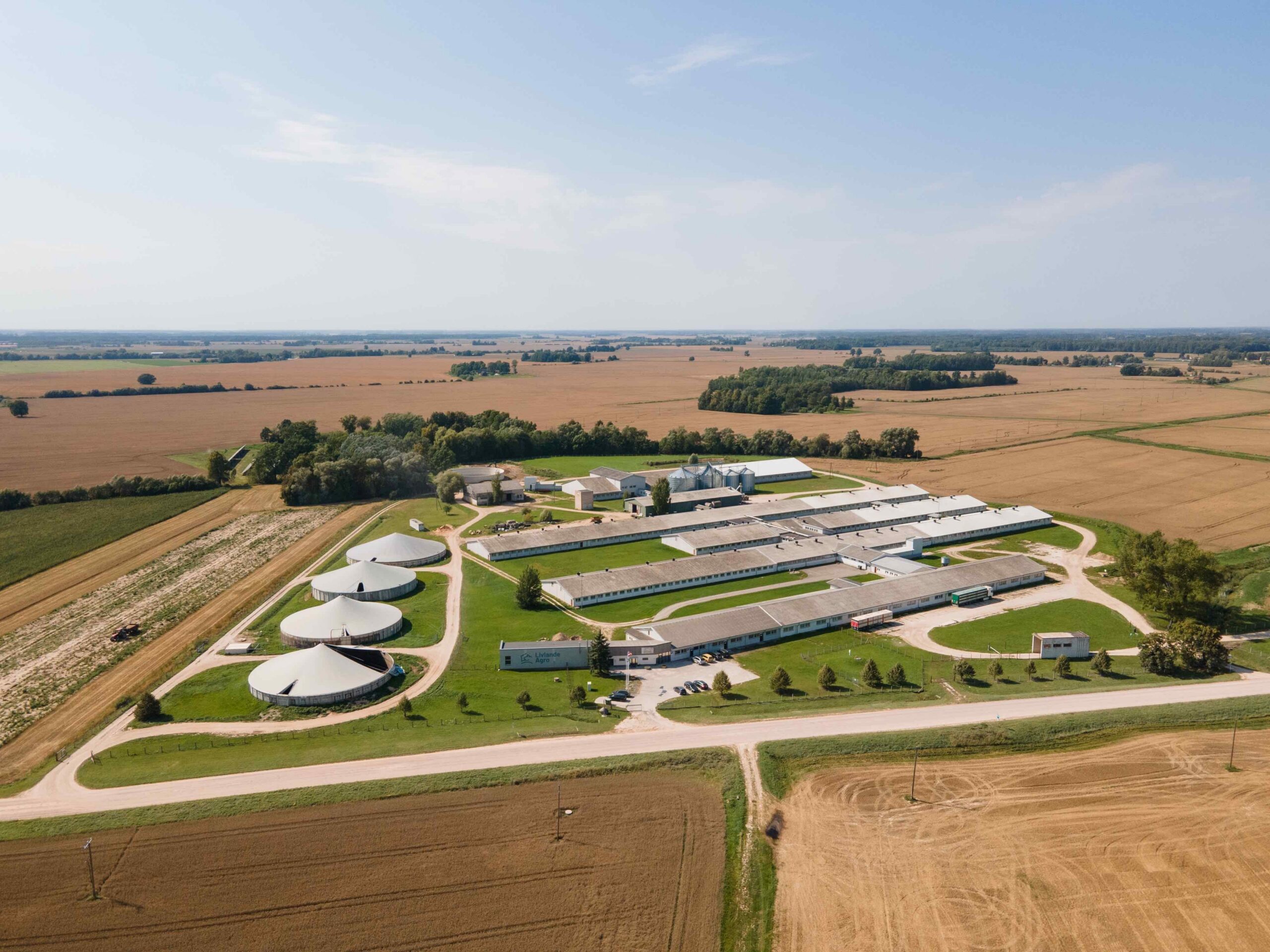
Livlande yra antra didžiausia kiaulininkystės grupė Latvijoje, valdanti apie 20% vidaus rinkos, ir svarbi tiekėja klientams Lietuvoje. Bendrovė valdo keturias fermas – dvi netoli Cėsio ir dvi netoli Bauskės – ir per metus išaugina daugiau nei 100 000 mėsinių kiaulių. Verslas yra vertikaliai integruotas: didelę dalį pašarų bendrovė pasigamina pati nuosavoje 1 414 hektarų žemės ūkio paskirties žemėje ir daugiau nei 400 hektarų nuomojamos žemės plotuose, vietoje gamina saulės energiją, o organines trąšas naudoja uždaro ciklo sistemoje.

Skaičiai aiškūs ir patys kalba už save. 2025 m. pajamos siekė 17,1 mln. eurų. Normalizuota EBITDA sudarė 5,4 mln. eurų. Nuosavo kapitalo koeficientas buvo 88%. Per visą savo istoriją bendrovė niekada nepatyrė nuostolių, o nuo 2022 m. akcininkams išmokėjo daugiau nei 14,5 mln. eurų dividendų ir kapitalo mažinimo išmokų forma, papildomai grąžindama 4,8 mln. eurų skolos finansuotojams.

€17.1m
Pajamos 2025
€5.4m
Normalizuota EBITDA
20%
Rinkos dalis
1 414 ha
Nuosavos žemės plotas

Livlande išskirtinė ne dėl masto, o dėl efektyvumo. Lyginant su regionu ir Jungtinės Karalystės sektoriaus vidurkiais, Livlande vienai paršavedei tenka daugiau paršelių, nugaišimo lygis po nujunkymo yra mažesnis, o pašarų sąnaudos vienam kilogramui kiaulienos yra mažesnės. Esant identiškoms gamybinėms ir rinkos sąlygoms, šis efektyvumo pranašumas reiškia apie 1,4 mln. eurų didesnę metinę EBITDA, palyginti su sektoriaus vidurkiu. Šis pranašumas buvo kuriamas dešimtmečius ir yra praktiškai nepasiekiamas naujesniems ar mažesniems rinkos dalyviams.

Kiauliena yra populiariausia mėsa Baltijos šalyse, tačiau vietinė gamyba reikšmingai atsilieka nuo paklausos, todėl apie 50% suvartojamos mėsos yra importuojama. Todėl visi didieji vietos rinkos dalyviai, įskaitant Livlande, yra sisteminės reikšmės bendrovės, veikiančios rinkoje su itin aukštais įėjimo barjerais. Baltijos kiaulininkystės rinka konsoliduojasi. Industrinio masto fermos, turinčios daugiau nei 500 paršavedžių, išlaikė savo pozicijas, o mažos fermos uždaromos. Penki didžiausi Latvijos rinkos dalyviai šiandien kontroliuoja 60-70% rinkos. Livlande turi visas galimybes toliau didinti savo rinkos dalį tiek organiškai, tiek per įsigijimus.

Sandorio struktūra

Visa sandorio vertė buvo finansuota iš 9 mln. eurų nuosavo kapitalo, 11 mln. eurų obligacijų emisijos ir kelių milijonų eurų atidėtų mokėjimų. Merito ir bendrainvestuotojai į nuosavą kapitalą įnešė 9,1 mln. eurų. Skolos dalį suformavo 11,0 mln. eurų privataus platinimo aukščiausios eilės užtikrintų obligacijų emisija, organizuota Signet Bank, užtikrinta fermų ir žemės įkeitimu, taikant konservatyvų 51% LTV (paskolos ir vertės santykį). Emisija buvo viršyta. Bendrovės įkūrėjas ir generalinis direktorius perkėlė savo turimą dalį į naują struktūrą ir padidino savo akcijų paketą iki maždaug 12,5%, kartu investuodamas ir į obligacijas. Tolesni mokėjimai pardavėjams priklauso nuo ateities veiklos rezultatų ir yra struktūruoti taip, kad suteiktų nuosavo kapitalo turėtojams reikšmingą apsaugą nuo nuosmukio rizikos.

Obligacijų kupono norma – 7,5%, mokama kas ketvirtį, obligacijų terminas – 3,5 metų. Per dvylika mėnesių planuojamas obligacijų įtraukimas į prekybą Nasdaq Riga First North sąraše. Obligacijų investuotojų interesus saugo pirmos eilės įkeitimas tiek į nekilnojamąjį turtą, tiek į veiklą vykdančios bendrovės akcijas.

Tai didžiausias Merito iki šiol įvykdytas privataus kapitalo išpirkimo sandoris ir sudėtingiausias mūsų iki šiol įgyvendintas sandoris. Šis sandoris mus perkelia į kitą lygį tiek sandorio dydžio, tiek kapitalo struktūros, tiek matomumo visame Baltijos regione atžvilgiu.

Kas laukia Livlande toliau

Livlande turi visus leidimus, reikalingus organiškai padidinti gamybos pajėgumus maždaug 20%, sektoriuje, kuriame naujų leidimų gavimas yra vienas pagrindinių barjerų patekti į rinką. Be to, Latvijos kiaulininkystės rinkoje yra keletas reikšmingų potencialių įsigijimo objektų, kai kuriuose iš jų artimiausiu metu vyksta aktyvūs kartų kaitos procesai. Taip pat yra galimybių energetikos srityje, kurias įvertinsime kaip ilgesnio laikotarpio strategijos dalį.

Pagrindas yra tvirtas, verslas buvo nuosekliai prižiūrimas, o fermos yra geros techninės būklės. Mes tuo pasinaudosime ir anksčiau aprašytas galimybes plėtosime aktyviau, nei tai leido ankstesnė akcininkų struktūra.

Section 2

Nuo pat pradžių sakėme, kad Merito ieško situacijų, kuriose investavimo galimybę sukuria nuosavybės pasikeitimas, o ne makroekonominis statymas ar sektoriaus dinamika. Livlande yra aiškiausias pavyzdys, kaip ši strategija veikia dideliu mastu.

Alex Rasmussen verslą įkūrė 1997 m. Jis verslą kūrė nuo nulio, plėtojo pasitelkdamas Danijos privataus kapitalo investicijomis, vėliau – institucinį NCH kapitalą, ir atvedė bendrovę į rinkos lyderės poziciją. Po daugiau nei 15 metų instituciniai akcininkai panoro likvidumo. Alex siekė užtikrinti verslo tęstinumą ir pritraukti kapitalo tolesniam augimui. Taip atsiradusi galimybė, motyvuotas pardavėjas kartu su itin kompetentinga vadovų komanda, kuri pasilieka, yra būtent tai, ko ieškome.

Baltijos šalių mastu: kas po Livlande?

Kitas sandoris jau yra procese, o tolesnis projektų srautas taip pat formuojasi. Vertiname keletą stambių bendrovių: vienos veikia visoje Baltijoje, kitos yra nacionaliniai sektorių lyderiai. Visas jas sieja ta pati investicinė logika, kuri atvedė mus prie Livlande – kartų kaitos situacija plačiąja prasme. Tai gali reikšti įkūrėjų kartą, pasirengusią perduoti vairą, institucinius investuotojus, dešimt ar penkiolika metų laikiusius savo investicijas ir ieškančius patikimos pasitraukimo galimybės, arba nuosavybės struktūras, kurios tiesiog jau nebeatitinka pirminės paskirties. Visais šiais atvejais pats verslas yra solidus – trūksta tik tinkamo naujo savininko. Manome, kad būtent čia ir yra Merito vieta.

Detalėmis pasidalinsime, kai tik procesas tai leis. Kol kas tik pažymėsime: jeigu Livlande patvirtino mūsų gebėjimą sėkmingai įgyvendinti privataus kapitalo išpirkimo sandorį Latvijoje, kitas žingsnis – įrodyti, kad tas pats požiūris veikia ir Baltijos šalių mastu.

Merito nekeičia strategijos. Įgyvendiname ją didesniu mastu ir su aiškiu siekiu sukurti reikšmingą Baltijos regiono investavimo platformą, apimančią bendroves, kurioms reikia tinkamesnių savininkų.

Kas toliau

2026 m. II ketvirtis buvo aktyviausias ketvirtis Merito istorijoje, o vasarai numatytų projektų srautas rodo, kad tempas nelėtėja. Livlande išpirkimo sandoris buvo svarbiausia naujiena, tačiau tai tik viena iš daugelio vienu metu vykstančių iniciatyvų. Lygiagrečiai dirbame su keliais svarbiais sandoriais ir projektais: baterijų energijos kaupimo sprendimais (BESS) mūsų saulės energijos portfelyje, naujomis nekilnojamojo turto specialiosiomis situacijomis, fondu, investuojančiu į Mintos augimo istoriją, ir sveikatos priežiūros sektoriaus konsolidacijos projektu. 

Daug kas nuveikta. Daug kas pradėta. Vasara bus intensyvi.

Mūsų esamiems investuotojams dėkojame už pasitikėjimą, kurį mums suteikėte, kai kuriais atvejais net tuomet, kai dar neturėjome veiklos istorijos tokio tipo sandoriuose. Tiems, kurie kol kas stebi iš šalies, mūsų durys atviros.

📧  investor.relations@meritopartners.com

🌐  Noriu investuoti

— Merito Partners komanda

Merito Partners Jaunumi Q2 2026

Izdevums Nr.19
Jūnijs 2026

Šis izdevums tiek izsūtīts nozīmīgā brīdī Merito attīstībā. Pēc astoņpadsmit mēnešu darba – padziļinātas izpētes, sarunām, darījuma strukturēšanas un noslēgšanas – esam pabeiguši līdz šim lielāko Merito privātā kapitāla izpirkšanas darījumu. Livlande Agro, efektīvākā cūkkopības uzņēmumu grupa Baltijā, iegāde tika noslēgta 2026. gada jūnijā. Tas ir sarežģītākais darījums, ko esam īstenojuši, un tas iezīmē jaunu posmu Merito Partners attīstībā.

Šis darījums nemaina Merito būtību – tas to apstiprina. Mēs vienmēr esam koncentrējušies uz īpašnieku maiņas situācijām Baltijas reģionā, kur pārejas periodi rada iespējas, kas vairumam institucionālo investoru ir pārāk īsas, lai uz tām reaģētu. Livlande ir tieši šāds gadījums – nozares līderis, ko izveidojis un vadījis tā dibinātājs, un kas tagad ieiet nākamajā attīstības posmā ar Merito kā stratēģisko partneri.

Section 1

2024. gada beigās sākām nopietni interesēties par Ģaižēni SIA, kas strādā ar zīmolu Livlande Agro. Darījums tika pilnībā noslēgts 2026. gada jūnijā. Astoņpadsmit mēnešu darbs pie tā, ko iekšēji dēvējām par Project Truffle, vainagojās ar vienu no pēdējo gadu lielākajiem vietējā kapitāla izpirkuma (buy-out) darījumiem Latvijā.

Darījums precīzi atbilst Merito mērķa investīcijas prasībām: dibinātāja vadīts uzņēmums ar 29 gadu pieredzi, institucionālas kvalitātes pārvaldību un investora pārmantojamības dinamiku, kas radījusi iespēju logu ārējam investoram. NCH Capital un sākotnējie Dānijas finanšu investori ar uzņēmumu bija saistīti vairāk nekā piecpadsmit gadus. Viņi bija gatavi pārdot savas daļas un iziet no dalībnieku sastāva, savukārt uzņēmuma dibinātājs un izpilddirektors Alex Rasmussen nekur negrasījās doties – viņš vēlējās, lai uzņēmums turpina augt kopā ar jauniem partneriem, vienlaikus palielinot savu līdzdalību uzņēmumā.

Kas ir Livlande Agro?

Livlande ir otrā lielākā cūkkopības grupa Latvijā ar aptuveni 20 % vietējā tirgus. Tā apsaimnieko četras saimniecības – divas pie Cēsīm, divas pie Bauskas – un saražo vairāk nekā 100 000 nobarojamo cūku gadā. Uzņēmums ir vertikāli integrēts: tas izaudzē būtisku daļu savas barības 1 414 hektāros pašu aramzemes un vairāk nekā 400 hektāros nomātas zemes, ražo saules enerģiju uz vietas savās fermās un izmanto cūku kūtsmēslus kā mēslojumu slēgtā cirkulārā ražošanā.

Skaitļi ir pārliecinoši. 2025. gadā ieņēmumi €17.1 miljoni. Normalizētā EBITDA €5.4 miljoni. Pašu kapitāla rādītājs 88 %. Uzņēmums nekad nav strādājis ar zaudējumiem, un kopš 2022. gada tas dividendēs un pamatkapitāla atgriešanā dalībniekiem ir izmaksājis vairāk nekā €14.5 miljonus, tikmēr aizdevējiem atmaksājot papildus €4.8m.

€17.1m
Ieņēmumi 2025
€5.4m
Normalizētā EBITDA
20%
Tirgus daļa Latvijā
1 414 ha
Pašu aramzeme

Livlande izceļas nevis ar apjomu, bet ar efektivitāti. Salīdzinājumā ar Latvijas un Lielbritānijas etaloniem Livlande iegūst vairāk sivēnu no vienas sivēnmātes, tai ir zemāka mirstība pēc atšķiršanas un tā patērē mazāk barības uz vienu cūkas svara kilogramu. Identiskos ražotnes un tirgus apstākļos šī efektivitātes priekšrocība gadā nozīmē aptuveni €1.4 miljonus lielāku EBITDA salīdzinājumā ar nozares vidējiem efektivitātes rādītājiem. Šī priekšrocība ir veidota gadu desmitiem, un jaunākiem un mazākiem tirgus dalībniekiem to nav iespējams atkārtot.

Lai gan cūkgaļa ir visvairāk patērētā gaļa Baltijā un Latvijā, šeit ir būtisks ražošanas deficīts (~50 % importētas gaļas), un tāpēc visi lielākie vietējie tirgus dalībnieki, tostarp Gaižēni, ir sistēmiski uzņēmumi ar ļoti spēcīgām barjerām ienākšanai tirgū. Baltijas cūkkopības tirgus konsolidējas. Rūpnieciska mēroga saimniecības ar 500+ sivēnmātēm ir noturējušas savas pozīcijas, savukārt mazās saimniecības pazūd. Pieci lielākie tirgus dalībnieki Latvijā jau kontrolē 60–70 % tirgus. Livlande ir labi pozicionēta, lai turpinātu palielināt savu daļu – gan organiski, gan pārņemot citus tirgus spēlētājus.

Darījuma struktūra

Kopējā uzņēmuma vērtība tika finansēta ar €9 miljoniem pašu kapitāla, €11m obligāciju un vairākiem miljoniem eiro atliktajos maksājumos. Merito un līdzinvestori ieguldīja €9,1 miljonus pašu kapitālā. Bet €110 miljonu ieguldīja pirmās kārtas nodrošināto (51% LTV) obligāciju investori. Obligāciju emisiju organizēja Signet Bank un pieprasījums pārsniedza piedāvājuma apmēru. Uzņēmuma dibinātājs un izpilddirektors saglabāja savu līdzdalību un palielināja to līdz aptuveni 12,5 %, vienlaikus piedaloties arī kā obligāciju investors. Turpmākie maksājumi pārdevējiem ir balstīti uz nākotnes rezultātiem un strukturēti tā, lai nodrošinātu būtisku aizsardzību pret riskiem pašu kapitāla turētājiem.

Obligācijām ir 7,5 % kupons, kas tiek izmaksāts reizi ceturksnī, ar 3,5 gadu termiņu. Iekļaušana Nasdaq Riga First North sarakstā ir plānota divpadsmit mēnešu laikā. Obligāciju investoriem ir pirmās kārtas ķīlas tiesības gan uz nekustamo īpašumu, gan uz darbības uzņēmuma akcijām

Šī ir Merito lielākais izpirkuma (buy out) darījums, kas vienlaicīgi ir arī mūsu sarežģītākais darījums līdz šim. Tas mūs ieved citā līgā darījuma apjoma, kapitāla struktūras, un redzamības ziņā.

Kas Livlande gaida tālāk

Livlande ir visas nepieciešamās atļaujas, lai organiski palielinātu jaudu par aptuveni 20 % – nozarē, kurā atbildīgo institūciju atļaujas ir viens no galvenajiem šķēršļiem ienākšanai tirgū. Turklāt Latvijas cūkkopības tirgū ir vairāki nozīmīgi iespējami iegādes darījumi, no kuriem vairākiem tuvākajā laikā ir aktuāli pēctecības izaicinājumi. Pastāv arī iespējas enerģētikas jomā, ko izvērtēsim kā daļu no ilgtermiņa stratēģijas.

Pamati ir stabili – uzņēmums ir konsekventi uzturēts, un saimniecības ir labā darbības kārtībā. Mēs uz tā balstīsimies un izmantosim iepriekš minētās iespējas aktīvāk, nekā to atļāva iepriekšējā īpašnieku struktūra.

Section 2

Kopš pirmssākumiem esam teikuši, ka Merito mērķē uz situācijām, kurās investīciju iespēju rada īpašumtiesību maiņa  nevis makroekonomiska likme vai nozares dinamika. Livlande ir skaidrākais piemērs tam, kā šī tēze darbojas mērogā.

Alex Rasmussen dibināja uzņēmumu 1997. gadā. Viņš to izveidoja no nulles, izvērsa ar Dānijas privātā kapitāla un vēlāk NCH institucionālā kapitāla palīdzību un noveda to līdz tirgus līderpozīcijai. Pēc 15+ gadiem institucionālie akcionāri vēlējās likviditāti (ieguldījumu atgūšanu). Alex vēlējās nepārtrauktību un izaugsmes kapitālu. Radušais iespēju logs – motivēts pārdevējs apvienojumā ar ļoti spējīgu vadības komandu, kas paliek savās pozīcijās – ir tieši tas, ko meklējam.

Merito – kas sekos tālāk pēc Livlande

Nākamais darījums jau ir procesā, un arī tālākā darījumu plūsma sāk iezīmēties. Mēs aplūkojam vairākus apjomīgus uzņēmumus – dažus ar Baltijas mēroga darbību, dažus nacionālos nozares līderus. Tos vieno tas pats aspekts, kas mūs atveda pie Livlande: pēctecības situācija plašākā nozīmē. Tas var nozīmēt dibinātāju paaudzi, kas gatava atdot stūri citam, kā arī institucionālos investorus, kuri pozīciju turējuši desmit vai piecpadsmit gadus un kuriem nepieciešams uzticams izejas (pārdošanas) ceļš, vai īpašnieku struktūras, kas vienkārši pāraugušas savu sākotnējo mērķi. Visos gadījumos pats uzņēmums ir dzīvotspējīgs; trūkst īstā nākamā īpašnieka. Mēs uzskatām, ka Merito ir tieši šāds partneris.

Dalīsimies ar detaļām, tiklīdz process to ļaus. Pagaidām vienkārši atzīmēsim: ja Livlande apstiprināja mūsu spēju īstenot privātā kapitāla izpirkšanu Latvijā, nākamais solis ir pierādīt, ka tā pati pieeja darbojas arī plašākā mērogā.

Merito nemaina stratēģiju. Mēs to īstenojam lielākā mērogā – un ar skaidrāku mandātu veidot nozīmīgu Baltijas investīciju platformu ap uzņēmumiem, kuri ir pelnījuši ilgtspējīgu atbalstu no mērķtiecīgiem īpašniekiem.

Skatoties nākotnē

2026. gada 2. ceturksnis ir bijis aktīvākais ceturksnis Merito vēsturē, un darījumu plūsma šobrīd liecina, ka temps nemazinās. Livlande izpirkšana bija galvenā ziņa, taču tā nebūt nebija vienīgā lieta, kas notika. Mēs paralēli strādājam pie vairākiem nozīmīgiem darījumiem un iniciatīvām: BESS (akumulatoru enerģijas uzkrāšanas risinājumi) mūsu saules enerģijas portfelī, jaunas nekustamā īpašuma īpašās situācijas, “feeder” fonds Mintos izaugsmes situācijai un veselības aprūpes konsolidācijas platforma.

Daudz ir paveikts. Daudz ir iekustināts. Vasara būs darbīga.

Mūsu esošajiem investoriem – paldies par uzticību, ko mums dodat, dažos gadījumos vēl pirms mums bija pieredze šāda veida darījumos. Tiem, kas seko mums no attāluma: mūsu durvis ir atvērtas – laipni lūgti pievienoties.

📧  investor.relations@meritopartners.com

🌐  Vēlos Ieguldīt

— Merito Partners komanda

Merito Partners Newsletter Q2 2026

Update No.19
June 2026

This newsletter arrives at a significant milestone for Merito. After eighteen months of work — due diligence, negotiation, structuring, and closing — we have completed Merito’s largest private equity buy-out to date. The acquisition of Livlande Agro, the most efficient pig farming group in the Baltics, closed in June 2026. It is the most complex transaction we have executed, and it marks a new chapter for Merito Partners.

This transaction does not change what Merito is — it confirms it. We have always focused on succession-driven situations in the Baltic region, where ownership transitions create windows that are too short for most institutional capital to act on. Livlande is exactly that: a sector-leading business, built and run by its founder, now entering its next phase with Merito as the strategic partner.

Section 1

At the end of 2024, we started looking seriously at the Livlande Agro brand. By June 2026, we had closed. Eighteen months of work on what we internally called Project Truffle – culminating in one of the largest local capital buy-outs in Latvia in recent years.

The deal sits squarely in the kind of situation Merito was built for: a founder-led business with a 29-year track record, institutional-quality operations, and a succession dynamic that created a window of opportunity. NCH Capital and the original Danish financial investors had been with the company for over fifteen years. They were ready to exit, while the founding CEO, Alex Rasmussen, was not going anywhere – he wanted the business to continue growing with new partners and increase his stake in the business.

What is Livlande?

Livlande is the second-largest pig farming group in Latvia, with approximately 20% of the domestic market. It operates four farms – two near Cēsis, two near Bauska – producing over 100,000 finisher pigs per year. The business is vertically integrated: it grows a significant share of its own feed on 1,414 hectares of owned arable land and over 400 hectares of leased land, generates solar energy on-site, and uses pig manure as fertilizer in a closed-loop system.

The numbers are straightforward. Revenue of €17.1 million in 2025. Normalized EBITDA of €5.4 million. An equity ratio of 88%. The business has never posted a loss in its history, and since 2022, it has distributed more than €14.5 million through dividends and share capital reductions to its shareholders and an additional €4.8m to debt providers.

€17.1m
Revenue 2025
€5.4m
Normalized EBITDA
20%
Latvia market share
1 414 ha
Owned arable land

What makes Livlande exceptional is not the scale – it is the efficiency. Compared to Latvian and British benchmarks, Livlande produces more piglets per sow, has lower post-weaning mortality, and uses less feed per kilogram of pig weight. At identical facility and market conditions, that efficiency advantage translates to approximately €1.4 million more in EBITDA per year versus the industry average. That edge has been built over decades and is impossible to replicate for newer and smaller players.

While pork is the most consumed meat in the Baltics and Latvia, we experience a significant production deficit (~50% imported meat) and as a result all the major local players, including Gaižēni are systemic companies with very strong entry barriers.

The Baltic pig farming market is consolidating. Industrial-scale farms with 500+ sows have held their position, while small farms have closed down. The top five players in Latvia already control 60–70% of the market. Livlande is positioned to continue gaining share — both organically and through acquisition.

The deal structure

Total enterprise value was financed by €9 million of equity, €11m of bonds, and several million euros of deferred payments. Merito and co-investors contributed €9.1 million in equity. A private placement of €11.0 million in senior secured bonds – arranged by Signet Bank, secured against the farms and land at a conservative 51% LTV – was oversubscribed and provided the debt component. The founding CEO rolled over his stake and increased his shareholding to approximately 12.5% while also participating as a bond investor. Further payments to the sellers are based on future performance, structured to provide significant downside protection for equity holders.

The bonds carry a coupon of 7.5%, paid quarterly, with a 3.5 year maturity. Listing on Nasdaq Riga First North is planned within twelve months. Bond investors benefit from first-ranking pledges on both the real estate and the operating company shares.

This is Merito’s largest private equity buy-out – and our most complex transaction to date. It takes us into a different league in terms of deal size, capital structure, and Pan-Baltic visibility.

Livlande has all permits in place to expand capacity organically by approximately 20% in an industry where new permits are a key barrier to entry. Additionally, there are a handful of meaningful acquisition targets in the Latvian pig farming market, several of which have active succession situations in the near term. There are also energy-side opportunities we will evaluate as part of a longer-term strategy.

The foundations are solid – the business has been consistently maintained and the farms are in good operational order. We will build on that and pursue the opportunities above more actively than the previous ownership structure allowed.

Section 1

We have said since the beginning that Merito targets situations where a transition in ownership – not a macro bet, not a sector dynamic – creates the investment opportunity. Livlande is the clearest example of that thesis working at scale.

Alex Rasmussen founded the business in 1997. He built it from a greenfield project, scaled it through Danish private investment and later institutional capital from NCH, and took it to market leadership. After 15+ years, the institutional shareholders wanted liquidity. Alex wanted continuity and growth capital. The resulting window — a motivated seller combined with a highly capable management team that is staying put — is exactly what we look for.

Pan-Baltic: what comes after Livlande

The next transaction is already in progress – and the pipeline beyond it is taking shape. We are looking at several sizeable businesses, some with Pan-Baltic footprints, some national sector leaders. What unites them is the same angle that brought us to Livlande: a succession situation in the broadest sense. That can mean a founding generation ready to hand over the keys, institutional investors who have held a position for ten or fifteen years and need a credible exit path, or ownership structures that have simply outgrown their original purpose. In all cases, the business itself is sound; what is missing is the right next owner. We think that is where Merito fits.

We will share details as soon as the process allows. For now, we would simply note: if Livlande confirmed our ability to execute a private equity buy-out in Latvia, the next step is to demonstrate that the same approach works at Pan-Baltic scale.

Merito is not changing strategy. We are executing it at a larger scale – and with a clearer mandate to build a meaningful Pan-Baltic investment platform around businesses that deserve better ownership.

Looking Ahead

Q2 2026 has been the most active quarter in Merito’s history — and the pipeline going into the summer suggests that pace is not slowing down. The Livlande buy-out was the headline, but it was far from the only thing in motion. We are working in parallel on several significant transactions and initiatives: BESS (battery energy storage solutions) across our solar portfolio, new real estate special situations, a feeder fund for Mintos growth case and a healthcare consolidation play.

A lot has been done. A lot has been set in motion. Summer will be busy.

For our current investors, thank you for the trust you placed in us – in some cases before we had a track record in this type of transaction. For those following from the sidelines: our door is open.

📧  investor.relations@meritopartners.com

🌐  Click Here To Invest

— The Merito Partners Team
Merito Partners establishes the healthcare services platform MeDi Group

Merito Partners (Merito), in collaboration with industry expert Dins Šmits and Integer Consulting, has established the healthcare services consolidation platform MeDi Group to develop a professionally managed healthcare group and network of clinics across the Baltic region. It is planned that up to EUR 20 million of private investor capital will be invested in the platform. The total investment of MeDi Group in healthcare will be further increased through bank financing or bond issuance for each investment.

MeDi Group is being developed with the objective of building a professionally managed healthcare group by consolidating high-quality clinics offering diagnostic, treatment, rehabilitation, and wellness services.

Mikus Janvars, Co-founder and Managing Partner of Merito: “The establishment of MeDi Group marks Merito’s entry into long-term, evergreen investments in the healthcare sector—one of the most resilient and socially significant sectors in the Baltics. In response to long-term structural trends, including aging of population, historically low healthcare expenditure, and steady market growth, we see substantial development potential and an opportunity for long-term investment. MeDi Group will combine strong governance under the leadership of experienced industry professional Dins Šmits, excellence in medical and patient experience, and local capital, creating a company with significant growth potential and a positive contribution to the sustainability of healthcare.”

To support the development of the healthcare consolidation platform, the investment fund Merito Management Target Fund VI has been established. The initial capital raising phase has been completed, during which 10 private Latvian investors invested in the fund, and further investor onboarding will continue alongside the development of MeDi Group.

“The attraction of Latvian capital and investor confidence ensures sustainable development opportunities for MeDi Group. The first medical facility co-financed by MeDi Group —the ear, nose, and throat clinic LORENT, led by otolaryngologist Dr. med. Rūdolfs Jānis Vīksne—will open in May of this year. Overall, we plan to consolidate up to ten private clinics of various profiles, providing support and financing both for the development of existing private medical institutions and the establishment of new clinics,” says Dins Šmits, Head of MeDi Group.

About Integer Consulting

The sole owner of Integer Consulting, Dins Šmits, is a healthcare industry expert with more than 25 years of management and entrepreneurial experience in the healthcare sector. He is also a co-founder and partner in several high-quality medical institutions, including Prof. Skrides sirds klīnika, Baltijas ķirurģijas centrs, SIA Osteomed, as well as the fintech company bonusukarte.lv.

“Merito Partners” izveido veselības aprūpes pakalpojumu platformu “MeDi Group”

“Merito Partners” (“Merito”) kopā ar nozares ekspertu Dinu Šmitu un “Integer Consulting” ir izveidojuši veselības aprūpes pakalpojumu konsolidācijas platformu “MeDi Group”, lai Baltijas mērogā attīstītu profesionāli pārvaldītu veselības aprūpes grupu un klīniku tīklu. Plānots, ka “MeDi Group” platformā tiks ieguldīts privāto investoru kapitāls līdz 20 miljonu eiro apjomā. Kopējais “MeDi Group” ieguldījums veselības aprūpē tiks palielināts ar banku vai obligāciju finansējumu katrā investīcijā.

“MeDi Group” tiek veidota ar mērķi attīstīt Baltijas mēroga profesionāli pārvaldītu veselības aprūpes uzņēmumu grupu, apvienojot augstas kvalitātes klīnikas, kas piedāvā diagnostikas, ārstniecības, rehabilitācijas un labsajūtas pakalpojumus.

Mikus Janvars, “Merito” līdzdibinātājs un vadošais partneris: “”MeDi Group” izveide iezīmē “Merito” ilgtermiņa jeb evergreen investīciju ienākšanu veselības aprūpes jomā – vienā no noturīgākajiem un sabiedrībai nozīmīgākajiem sektoriem Baltijā. Reaģējot uz ilgtermiņa strukturālajām tendencēm, tostarp sabiedrības novecošanos, vēsturiski zemiem veselības aprūpes izdevumiem un stabilu tirgus izaugsmi, mēs šeit saredzam būtisku attīstības potenciālu un iespēju ieguldīt ilgtermiņā. “MeDi Group” apvienos spēcīgu pārvaldību pieredzējuša nozares profesionāļa Dina Šmita vadībā, medicīnisko un pacientu pieredzes izcilību, un vietējo kapitālu, radot uzņēmumu ar lielu izaugsmes potenciālu un pozitīvu ieguldījumu veselības aprūpes ilgtspējā.”

Veselības aprūpes konsolidācijas platformas attīstībai ir izveidots investīciju fonds “Merito Management Target Fund VI”. Šobrīd ir noslēdzies sākotnējais investīciju piesaistes posms, kura laikā fondā savus līdzekļus ieguldījuši 10 privātie Latvijas investori, un līdz ar “MeDi Group” tālāku attīstību, turpinās arī jaunu investoru uzņemšana.

“Latvijas kapitāla piesaiste un investoru uzticība nodrošina “MeDi Group” ilgtspējīgas attīstības iespējas.  Pirmā ar “MeDi Group” līdzfinansējumu izveidotā medicīnas iestāde – ausu, kakla un deguna klīnika “LORENT”, ko vada otolaringologs Dr. med. Rūdolfs Jānis Vīksne, – tiks atklāta šī gada maijā. Kopumā “MeDi Group” ietvaros plānojam konsolidēt līdz desmit dažādu profilu privāto klīniku, nodrošinot atbalstu un finansējumu gan jau esošo privāto medicīnas iestāžu attīstībai, gan jaunu klīniku izveidei,” norāda Dins Šmits, “MeDi Group” vadītājs.

Par “Integer Consulting”

“Integer Consulting” vienīgais īpašnieks Dins Šmits ir veselības nozares eksperts ar vairāk nekā 25 gadu vadības un uzņēmējdarbības pieredzi veselības jomā un ir līdzdibinātājs un partneris vairākās augstas kvalitātes medicīnas iestādēs, tai skaitā “Prof. Skrides sirds klīnika”, “Baltijas ķirurģijas centrs”, SIA “Osteomed” kā arī fintech uzņēmumā bonusukarte.lv.

Merito Partners agrees to acquire Latvia’s leading livestock and agricultural company Gaižēni

Merito Partners, together with its investors, has reached an agreement to acquire the agricultural company SIA Gaižēni, becoming its majority shareholder.

The transaction between the current owners of Gaižēni – U.S. investment fund group NCH Capital and minority shareholders from Denmark – provides that Merito Partners will become the majority shareholder, alongside the company’s founder and long-time CEO, Alex Rasmusen. This is the largest transaction in the agricultural sector in recent years and one of the largest national capital buyouts in Latvia’s history.

Mikus Janvars, Co-founder and Managing Partner of Merito Partners, commented:
“The acquisition of SIA Gaižēni marks Merito’s entry into one of the historically strongest sectors of the Baltic economy—agriculture. We are pleased to add the flagship of Latvia’s livestock industry to our long-term (evergreen) investment portfolio. As a result of this transaction, the company will come under the ownership of Latvian entrepreneurs.”

Gaižēni, Latvia’s leading livestock farming company, was founded in 1997. It currently operates four pig farms in the regions of Vidzeme and Zemgale and manages an agricultural land portfolio of 1,400 hectares. In 2024, the company’s turnover exceeded EUR 18.5 million, with profits reaching EUR 4 million.

The transaction states that the company’s management team will reinvest in its development alongside Merito. “The introduction of new investors is a carefully planned and strategically important step in the long-term development of Gaižēni. I am grateful to the previous investors for their long-standing support in the company’s growth. After 30 years of living and doing business in Latvia, I am truly pleased with the confidence shown by local investors. Local capital will help strengthen our long-term direction and contribute to the growth of Latvia’s agricultural sector,” said Alex Rasmusen, Founder and CEO of SIA Gaižēni.

A notification has been submitted to the Competition Council, and completion of the transaction is expected following its review and approval. The transaction is financed through investments from Latvian private investors, as well as bond financing arranged by Signet Bank.

Kārlis Cerbulis, Head of NCH Capital in the Baltics, commented:
“NCH Capital’s financing and long-term support have enabled SIA Gaižēni to become a leading livestock and agricultural company in Latvia. We are pleased that its growth will continue in cooperation with Latvian investors. We are also glad that the company’s founder and CEO, Alex Rasmusen, will continue to lead and develop the business going forward.”

“Merito Partners” vienojas par Latvijas vadošā lopkopības un lauksaimniecības uzņēmuma “Gaižēni” iegādi

Latvijas vadošais investīciju uzņēmums “Merito Partners” un tā investori noslēguši vienošanos par lauksaimniecības uzņēmuma SIA “Gaižēni” iegādi, lai kļūtu par tā vairākuma akcionāru.

Darījums starp līdzšinējiem “Gaižēni” īpašniekiem – ASV investīciju fondu grupu “NCH Capital” un mazākuma akcionāriem no Dānijas – paredz, ka “Merito Partners” (“Merito”) kļūst par “Gaižēnu” vairākuma akcionāru un īpašnieku kopā ar uzņēmuma dibinātāju un ilggadējo vadītāju Aleksu Rasmusenu. Šis ir pēdējo gadu lielākais lauksaimniecības nozares darījums un viens no lielākajiem nacionālā kapitāla izpirkuma darījumiem Latvijas vēsturē.

Mikus Janvars, “Merito Partners” līdzdibinātājs un vadošais partneris: “SIA “Gaižēni” iegāde iezīmē “Merito” investīciju ienākšanu vienā no Baltijas vēsturiski jaudīgākajiem tautsaimniecības sektoriem – lauksaimniecībā. Esam gandarīti, ka savu ilgtermiņa jeb evergreen investīciju portfeli papildinām ar Latvijas lopkopības nozares flagmani, kas šī darījuma rezultātā nonāks Latvijas uzņēmēju īpašumā.”

Latvijas vadošais cūkkopības uzņēmums “Gaižēni” ir dibināts 1997. gadā, šobrīd tā saimniecībā ir četras cūku fermas Vidzemē un Zemgalē un 1400 hektāru plašs lauksaimniecības zemju portfelis. “Gaižēnu” apgrozījums 2024. gadā pārsniedz 18,5 miljonus eiro un peļņa – četrus miljonus eiro.

Darījums paredz, ka uzņēmuma vadības komanda reinvestēs līdzekļus uzņēmuma attīstībā kopā ar “Merito”. “Jaunu investoru piesaiste ir rūpīgi plānots un stratēģiski nozīmīgs solis “Gaižēnu” ilgtermiņa attīstībā. Esmu pateicīgs līdzšinējiem investoriem par ilgstošo atbalstu “Gaižēnu” izaugsmē. Pēc 30 gadu dzīves un uzņēmējdarbības pieredzes Latvijā man ir patiess prieks par vietējo investoru uzticību, un uzskatu, ka vietējais kapitāls palīdzēs stiprināt uzņemto kursu ilgtermiņā, veicinot mūsu valsts lauksaimniecības nozares izaugsmi,” stāsta SIA “Gaižēni” dibinātājs un vadītājs Alekss Rasmusens.

Konkurences padomei ir iesniegts ziņojums, un darījuma noslēgšana plānota pēc tā izskatīšanas un apstiprināšanas. Darījuma finansēšanai izmantoti Latvijas privāto investoru ieguldījumi, kā arī AS “Signet Bank” organizētais obligāciju finansējums.

Kārlis Cerbulis, “NCH Capital” vadītājs Baltijas valstīs: “”NCH Capital” finansējums un ilggadējais atbalsts ir sniedzis iespēju SIA “Gaižēni” kļūt par vadošo lopkopības un lauksaimniecības uzņēmumu Latvijā. Esam gandarīti, ka “Gaižēnu” izaugsme turpināsies sadarbībā ar Latvijas investoriem. Tāpat ir prieks, ka uzņēmuma dibinātājs un vadītājs Alekss Rasmusens turpinās darbu un attīstīs uzņēmumu arī tālāk.”

Merito Partners Newsletter Q1 2026

Update No.18
March 2026

This edition focuses on real estate – specifically, what Merito Partners has built, what the numbers look like, and where the strategy is heading next. It covers why Riga is the right market, what the portfolio has delivered in less than 30 months of execution, and Arhitektu nams – the most ambitious project yet and a preview of where this strategy is heading.

It has been just over two years since Merito Partners closed its first real estate fund. In that time, the strategy laid out in Newsletter No. 15 has moved from thesis to track record – and the results are giving every reason to accelerate.

Three things are covered here. First, why Riga is the right market – and why the window is not permanent. Second, what the portfolio has delivered in less than 30 months of execution. And finally, Arhitektu nams – the most ambitious project yet, and a signal of what comes next.

Walk through central Riga on a weekday morning and you will see something increasingly rare in a European capital: buildings worth restoring, priced as if nobody wants them. We think quite a lot of people will want them soon.

A decade of caution left Latvia behind

The 2008 financial crisis hit Latvia harder than almost any other European economy. Property prices collapsed by more than 50%. Households spent years paying down debt rather than taking on new mortgages. Banks tightened standards. Developers stayed on the sidelines. It was a rational response to a genuine shock – but it created a structural gap that persists today.

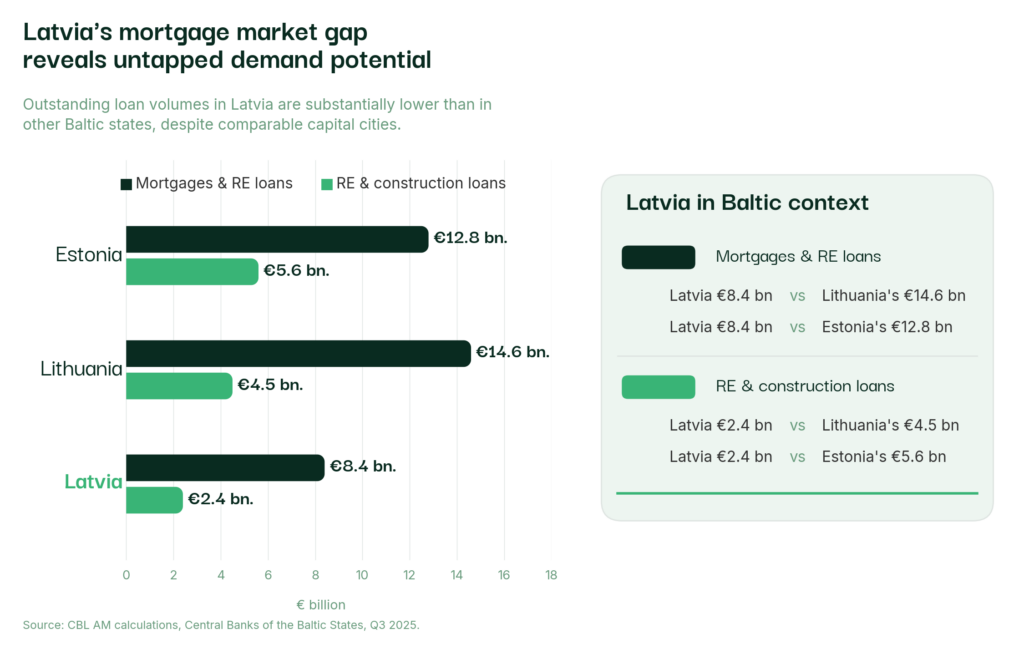
That gap is most visible in Latvia’s mortgage market. As of Q3 2025, outstanding mortgages and real estate loans in Latvia stood at roughly €8.4 billion – a fraction of Lithuania’s €14.6 billion and Estonia’s €12.8 billion. Traditionally, the vast majority of mortgages are concentrated in capital cities with comparable populations and income trajectories, presenting a major opportunity for Riga. Outstanding loans to real estate and construction tells the same story: €2.4 billion in Latvia, versus €4.5 billion in Lithuania and €5.6 billion in Estonia (Source: CBL AM calculations based on data from Central Banks of the Baltic States Q3 2025).

This is not weakness – it is latent demand. A population that has historically underinvested in homeownership, in a market where the conditions for doing so are now improving rapidly. As Latvian banks increase their appetite for real estate lending the pool of mortgage-eligible buyers expands. More buyers, same supply constraints. Supply, incidentally, is not rushing to catch up. New apartments entering the Riga market fell short of 2,200 units in 2025. The Colliers Latvia Residential Report 2025 projects roughly 2,500 units for 2026, rising to 3,000 in 2027 – enough to absorb demand at current pace, but not enough to rebuild the inventory buffer that the market has been drawing down (Source: Colliers Latvia Residential Report 2025).

The price gap that cannot last

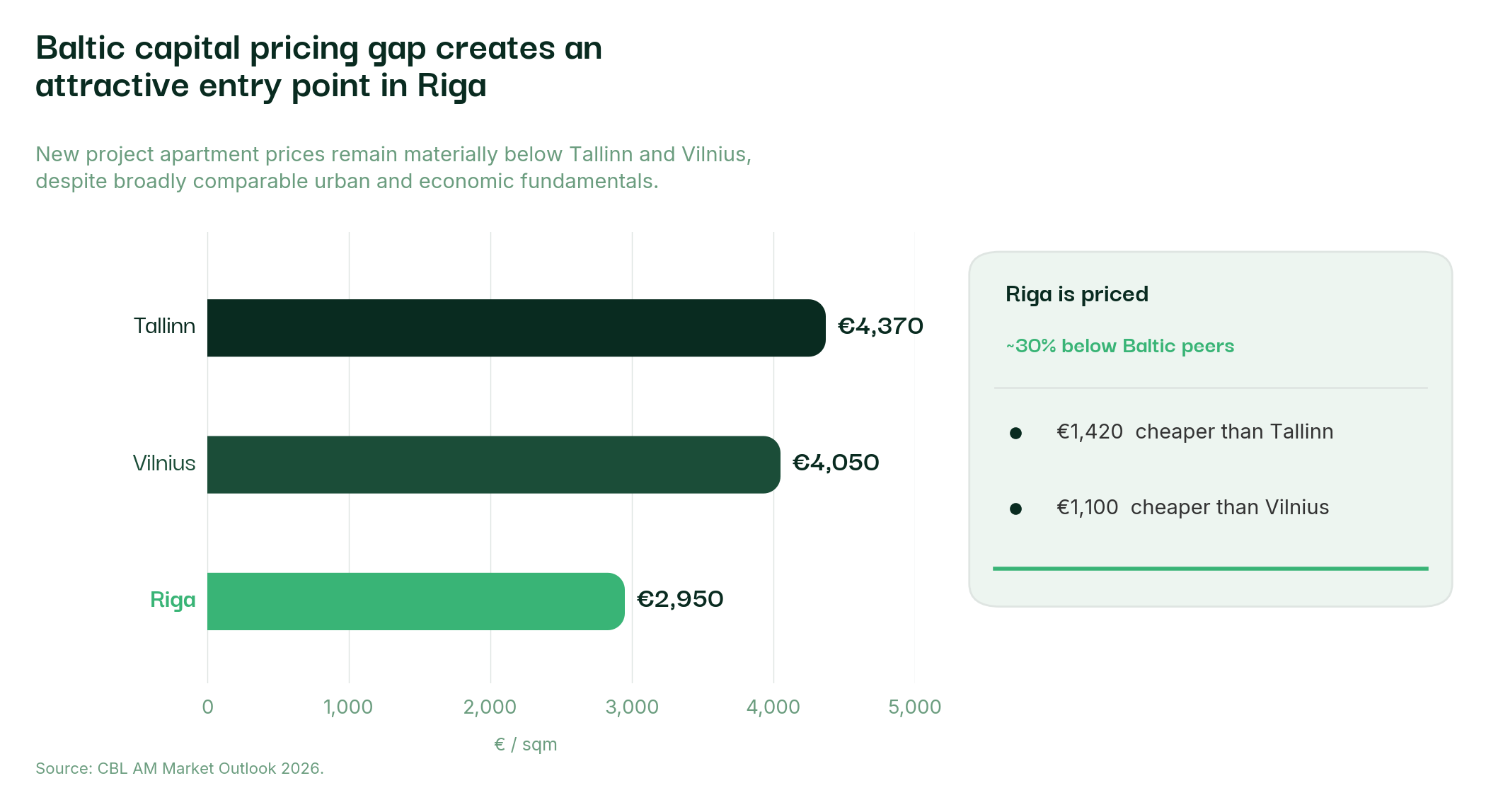
Which brings us to the number that matters most for investors analysing the return potential. New project apartments in Tallinn average: €4,370 per square metre. Vilnius: €4,050. Riga: €2,950. A 30–40% discount for a city with comparable history, urban quality, income level and professional workforce (Source: CBL AM, Market Outlook 2026).

That gap is not explained by demand – Riga’s primary market recorded 2,186 registered transactions in 2025, up 38% from 2024, generating a record €310 million in total deal value (Source: Colliers Latvia 2025). It is not explained by construction quality – the same developers active in whole Baltics are building in Riga. It is explained by the post-crisis undersupply, the recovering mortgage market, and the lag in developer confidence – all three of which are now visibly reversing.

When Colliers surveyed the active pipeline heading into 2026, developers who had been sitting on the sidelines through 2022 and 2023 were announcing large-scale projects and expanding land banks. Developers do not do that if they expect prices to fall.

For repositioning projects with 24–36 month horizons, the combination of low entry prices, expanding buyer pools, and a closing valuation gap creates a return profile that is difficult to replicate in markets that have already re-rated. That is the environment in which our real estate strategy operates – and that is why we are moving now.

We said in Newsletter No. 15 that Merito Real Estate Special Situations would run on two principles: partnering with agile developers who put their own capital at risk alongside ours, and targeting repositioning of undervalued or mismanaged assets that the market has mispriced. The question was always whether execution would match the thesis. We can now answer that.

The two approaches in a nutshell

1st Approach: Partner with developers who co-invest 15–35% of capital, accept an investor-first return structure, and operate under a Shareholder Agreement with Merito as an appointed Management Board member. The developer brings execution skill. We bring disciplined capital and governance. Interests are aligned from day one.

2nd Approach: Find properties that are undervalued, mismanaged, or simply underused – and reposition them through a focused 24–36 month strategy. Not speculative development. Not long holding periods waiting for macro tailwinds. Active value creation: acquire, renovate, convert, exit.

These are not abstract principles. Every fund in our portfolio – from the first closing in late 2023 to the latest one in 2026 – has been structured around one or both of them.

Where we started, and where we are

December 2023. Merito closes its first real estate fund – Kalēju 18/20, a property in Riga’s Old Town – with nine investors and €1.3 million in committed capital. At the time, we had no track record in real estate. What we had was a thesis, a team with deep local market knowledge, and the discipline to structure every deal with investor protection first.

By February 2024, we had closed a second fund – Pasta Street 6. By the second half of 2025, we were running six new funds in parallel, covering projects from Brīvības Street 138 to Skanstes Hof. Today, across ten funds, approximately 80 investors have made nearly 180 individual investment commitments, totalling close to €20 million.

Merito Real Estate Portfolio
Pausa Nams
Pausa Nams
Brīvības 138
Brīvības 138
Fiziķu Nams
Fiziķu Nams
Skanstehof
Skanstehof
Matīsa 27
Matīsa 27


The pace has not been accidental. Each new fund has benefited from the lessons of the previous one – better deal structuring, due diligence, tighter governance, more experienced counterparties.

The results that matter most

Pasta Street 6 is the clearest proof of concept so far. Acquired in February 2024 for a total investment of approximately €5 million including bank debt, the property’s market value had reached 2.0x Equity Multiple by June 2025 – a period of roughly sixteen months. All investor equity is already fully repaid and exit planning is underway. Expected returns in the range 20–30% IRR per annum. It was income-generating within 14 months of acquisition.

2025: The year execution became visible

2025 was the year the Merito real estate strategy moved from something investors trusted on paper to something they could see working in practice. Six new funds launched. Four of them under the developer-partnership model, two under the repositioning model.

The deals covered a range of property types – a former scientific facility on Krīvu Street, a historic residential block on Brīvības Street, a residential development project on Ģertrūdes Street, a new residential development at Hospitāļu Street in partnership with InCity Capital. Each project different. Each structured the same way.

Every now and then, a project comes along that does not just fit your strategy – it defines it. Arhitektu nams is that project for Merito Real Estate.

The building at Skolas Street 21 has stood in the Quiet Centre of Riga since 1987. Designed to house the Design Institute, it was built with the kind of structural generosity that Soviet-era public commissions occasionally produced: a reinforced concrete frame that has outlasted its original purpose by decades, high ceilings, wide corridors, and five elevators – a genuine rarity in buildings of this era and scale. It covers over 9,000 square metres. And until recently, it was sitting largely underused, its potential invisible to most of the market.

We acquired it for €5.9 million, co-financed with AS Signet Bank contributing €3.85 million. The total investment in the project is expected to surpass €14 million by completion.

What we are building

The transformation plan is straightforward in concept, demanding in execution: convert the building into approximately 250 compact studio and one-bedroom apartments, sized between 17 and 35 square metres, designed for the people who actually want to live in central Riga – students, young professionals, expats, long-term visitors. People for whom location matters more than space, and for whom the alternative is usually an ageing Soviet-era flat in a suburb, or an overpriced modern unit in a building that lacks character.

The Quiet Centre location is not incidental. Skolas Street 21 sits within walking distance of all key cultural and historical landmarks in central Riga and the established professional quarter of central Riga. It is, by any reasonable measure, a prime address – and it has been priced like it is not.

Beyond apartments, the plan incorporates commercial ground-floor space, co-working and recreational areas, storage solutions, and dedicated bicycle parking. These are not afterthoughts. They are the features that make a building genuinely liveable for the target demographic, and that drive long-term occupancy and rental income.

The numbers

Acquisition price€5.9 million
Bank financing (Signet Bank)€3.85 million
Total investment expected>€14 million
Building footprint>9,000 sqm
Target output~250 studios & 1BR apartments (17-35 sqm)
Equity raised€3.9 million from 22 private investors
Investment horizon36 months – renovate, convert, sell
Target net IRR20–30% per annum (MOIC ~1.8×)
Environmental advantage~50% lower impact vs. comparable new build

The environmental case is worth emphasising. Renovation of an existing concrete frame produces roughly half the carbon footprint of a comparable new construction. In a market increasingly attuned to sustainability credentials – and where EU green standards for residential buildings are tightening – this is not just an ethical argument. It is a commercial one.

A template, not a one-off

What makes Arhitektu nams significant is not just the scale – though at over 9,000 square metres and €14 million in total investment, it is the most ambitious project to date. What makes it significant is what it demonstrates: that Merito can identify, structure, and execute a project of this complexity with the same discipline applied to a €1.5 million single-building fund.

Work is already underway on another project that will exceed Arhitektu nams in scale. It is not ready to be announced yet – but it will be soon. What can be said is that investor appetite has been the clearest signal that this strategy is working. Across the portfolio, the total value of RE assets has reached €80 million, and plans already call for more than 600 new apartments across all projects.

The pipeline is not slowing down. It is accelerating. And we want our investors to be part of what comes next.

Interested in our next opportunity?

If the strategy we have described in this newsletter resonates with you – or if you are an existing investor curious about upcoming projects – we would be glad to talk.

📧  investor.relations@meritopartners.com

🌐  Click Here To Invest

— The Merito Partners Team